
info@jxgreentape.com
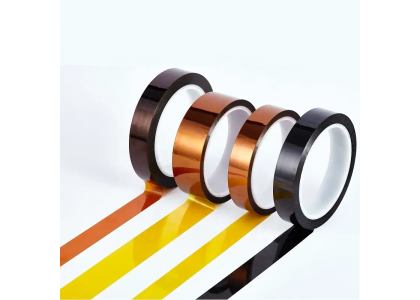
When you place a polyimide (Kapton-style) product on an assembly for protection, temporary masking, fixture-holding, or insulation, you change the local electrostatic environment. A material that is too conductive can create leakage paths and change circuit behavior; a material that is too insulating can let charge accumulate and build up high local potentials that discharge unpredictably. For many assembly and protective applications the engineering compromise lands in the 10^6–10^9 Ω per square band. Choosing an anti static polyimide tape with clear, tested surface resistivity performance is therefore a risk-management decision — not a marketing choice.
Surface resistivity (Ω/sq) — often reported as Ω per square — quantifies how easily charge flows along a surface layer. Volume resistivity (Ω·cm) measures bulk conductivity through the thickness. Decay time (seconds) measures how quickly a deposited charge dissipates to a reference level. All three numbers are relevant in different scenarios: for ESD control on a workbench you might prioritize decay time; for sensitive, high-impedance circuitry you will focus on surface and volume resistivity to avoid leakage.
A caution: terms like “ESD-safe” or “dissipative” are only meaningful when paired with the measurement method, the environmental conditions (temperature and relative humidity), and the electrode geometry used to measure them. When evaluating kapton tape for electronics, always insist on the test method and the raw numbers.
This numeric band arises from practical exposure on production lines. At roughly 10^6 Ω/sq, surfaces bleed static fast enough to avoid common sparking events in many assembly environments. At about 10^9 Ω/sq, you still retain considerable insulating behavior — important when you cannot allow a low-impedance surface near sensitive nodes. The band is a compromise: it reduces the likelihood of surface arcing while avoiding creation of a conductive sheet that could alter circuit test results or introduce leakage.
Context matters: a connector mating surface or a gold-finger area may tolerate a slightly more dissipative tape to prevent charge accumulation; a high-value instrumentation front-end may prefer higher resistivity or additional grounded shields and handling protocols. The correct spec always arises from risk assessment plus measured validation.
A precise procurement spec must state:
The test standard to use (e.g., ASTM D257, IEC 60093, or a guarded-ring method).
Environmental conditioning (e.g., 23°C ±2°C, 50% RH; also provide 12% RH dry-line data where applicable).
Measurement geometry and electrode spacing (guarded ring vs two-point).
Units and significant figures (report raw reading, e.g., 5.2 × 10^7 Ω/sq, not only a category).
Pre-conditioning or cleaning (IPA wipe vs as-received) before measurement.
Common measurement mistakes include testing in uncontrolled humidity (which can shift readings by orders of magnitude), measuring on contaminated samples, or failing to specify electrode geometry. For kapton tape sds and resistivity reporting, insist on both vendor lab results and raw logs that show replicate readings and standard deviation.
Use a guarded-ring electrode for surface resistivity tests to reduce edge leakage error. Condition samples at your target humidity and temperature for at least 24 hours. Run several (5–10) readings across the roll to capture variability and report mean ± standard deviation. Calibrate instruments with known standards and run inter-lab comparisons when suppliers provide third-party test reports.
When your process includes heat (reflow, wave solder, localized welding), specify post-thermal measurements. Example: “Surface resistivity (guarded-ring) = X × 10^y Ω/sq at 23°C, 50% RH; post-thermal exposure reading at the same conditions after a simulated 260°C short-term peak = Y × 10^z Ω/sq.” Without post-process verification the number is incomplete for kapton tape for soldering applications.
SMT / Wave solder masking: target 10^7–10^9 Ω/sq for temporary protective masks — enough dissipation to avoid charge buildup while maintaining insulation. Verify after full thermal profile. Use kapton tape for soldering products with verified post-thermal readings and residue performance.
Battery module and cell handling: target the middle of the band (10^6–10^8 Ω/sq) to aid dissipation during handling while avoiding conductive paths near tabs. Prefer anti static polyimide tape formulations tested with your welding and varnishing profile.
Sensitive sensor and high-impedance circuits: skew to the higher end (10^8–10^10 Ω/sq) only if your process and handling protocols control charge sources — often additional grounded shielding and operator controls are needed rather than relying solely on tape resistivity.
Motor coil and winding protection: typical assemblies tolerate the mid-band values; however, confirm compatibility with varnishes and curing cycles because adhesives can leave residues that change effective surface resistivity.
Include the following items in RFQs and POs:
Full kapton tape sds and TDS with clear adhesive chemistry (silicone vs acrylic) and film composition.
A clear statement of the test method used to measure surface resistivity and volume resistivity, including environmental conditions.
Batch test certificates showing representative readings (with mean and standard deviation) and batch/lot number traceability.
Post-thermal exposure measurements if your process includes reflow, wave, or baking steps.
Post-peel residue data and a defined residue test method (mg/cm² measurement).
Third-party lab reports where possible and references from similar industry customers.
If a supplier claims “antistatic” without supplying the kapton tape sds plus numerical results for resistivity and post-process stability, treat that as incomplete. A serious kapton tape manufacturer and supplier will provide method-level detail and allow limited samples for buyer testing.
Case 1 — A camera module SMT line (realistic simulated):
A medium EMS replaced a generic heat-resistant tape with a product labeled for ESD control. The supplier provided guarded-ring results: 2.5 × 10^7 Ω/sq at 23°C/50% RH with post-reflow reading within 10% of the original. Engineering validated the product on small runs and observed a 48% drop in functional-test ESD failures over three months. The key win: a documented method + post-process data allowed confident adoption of the kapton tape for electronics.
Case 2 — Battery module tab handling (practical pilot):
A battery supplier trialed a silicone-adhesive polyimide tape as a tab protector during resistance welding. Procurement specified post-weld residue ≤ 0.10 mg/cm² and required resistivity measurements after two thermal cycles. The tape maintained resistivity in the targeted band (mid-10^6 to low-10^8 Ω/sq) and showed negligible residue, preventing intermittent shorts and reducing rework. This validated the use of an anti static polyimide tape in a high-risk area.
Case 3 — High-impedance sensor production:
A precision sensor maker required a resistivity upper bound to avoid low-level leakage. The supplier provided guarded-ring tests at low RH (12% RH) to simulate dry-line conditions. The validated tape met the tighter spec, and the manufacturer paired that material with operator grounding procedures, ensuring the tape did not become a leakage path during final calibration.
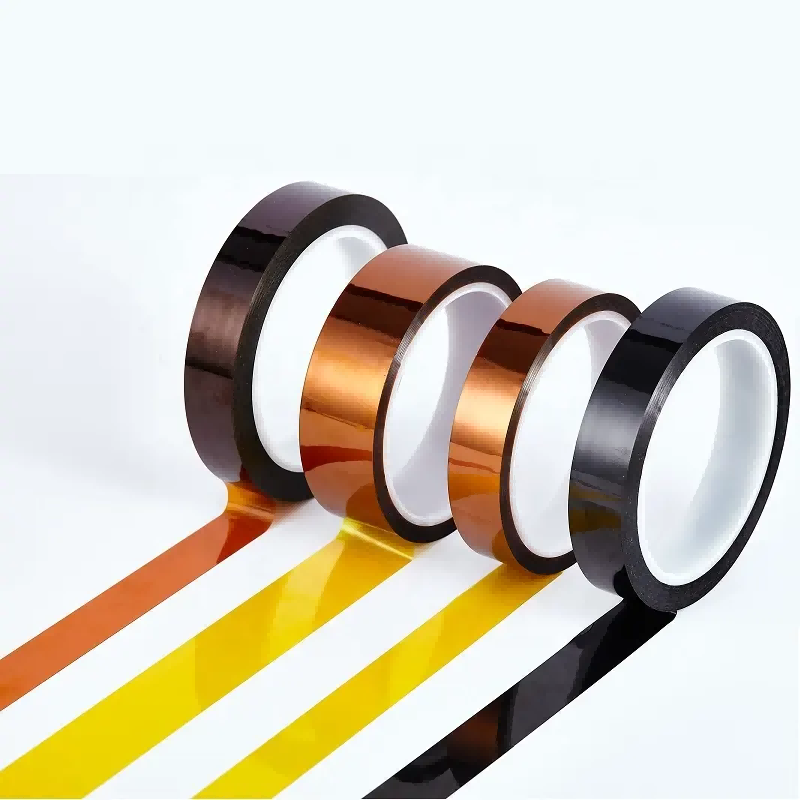
Test method: “Surface resistivity (guarded-ring / ASTM D257) measured at 23°C ±2°C, 50% RH. Report mean ± standard deviation and raw replicate readings.”
Target range: “Bid surface resistivity range: 1 × 10^6 to 1 × 10^9 Ω/sq. Provide prior lab data proving initial and post-thermal readings within this range when exposed to buyer’s specified thermal profile.”
Post-process checks: “Provide peel force (N/25 mm) pre- and post-process, adhesive residue mg/cm² measured by agreed method, and TGA/DSC trace for film and adhesive.”
Documentation: “Supply kapton tape sds, full TDS, batch test certificate with roll/lot traceability, and third-party lab reports if available.”
Samples and evaluation: “Supplier to provide at least three full-width sample strips for buyer’s process trials; 2-week sample evaluation period allowed with up to 20 assemblies for testing.”
Troubleshooting — quick field checks and FAQ for engineers
Q — My tape reads within spec in the lab but changes after wave solder. Why?
A — Adhesive chemistry or surface coatings may oxidize, crosslink, or char under thermal stress. Always require and test post-thermal exposure resistivity and residue data for kapton tape for soldering.
Q — A vendor gives a single resistivity number but no method. Is that useful?
A — No. Resistivity depends on measurement geometry, humidity, and electrode spacing. Insist on the method and replicate readings.
Q — What simple shop-floor checks can we run?
A — Keep a handheld surface resistivity meter and conditioned samples of known reference material to check incoming lots. Verify appearance, tack, and a simple peel test on a control board before full-line use.
Q — Do we prefer silicone adhesives or acrylics for ESD tapes?
A — It depends. Silicone adhesives tend to have better high-temperature removability and lower residue; high-temp acrylics can offer stronger initial tack at lower cost. For critical “clean removal” applications — for example, protecting gold-fingers or delicate tab areas — prefer silicone-based anti static polyimide tape when supplier data supports it.
Q — Is “antistatic” labeling enough for procurement?
A — No. Always request the kapton tape sds and resistivity data with method, environmental conditions, and post-process results.
Treat resistivity numbers as context-dependent — always specify the measurement method and environmental conditioning.
Require the kapton tape sds, TDS, and batch certificates; do not accept unlabeled “antistatic” claims.
Validate any candidate tape in YOUR full process including thermal profiles and flux chemistries; require post-process readings.
Use guarded-ring electrode methods and report mean ± standard deviation; sample multiple points across the roll.
For critical high-impedance products, demand third-party lab data and field references.
Codify acceptance criteria in the PO to reduce qualification cycles and speed supplier accountability.
Make traceability and raw data part of the acceptance gate: require batch/lot numbers on rolls, retain tested sample strips with recorded readings, and ask suppliers for raw measurement logs so you can audit results if an issue arises. The right kapton tape manufacturer and supplier will support this level of documentation and make your process qualification and scale-up smoother.