
info@jxgreentape.com
Industrial packaging tape is not only used to seal cartons. In export packaging, warehouse handling, appliance transport, and component bundling, reinforced tape often has to do more serious work: strengthen carton edges, hold long parts together, reduce movement inside the package, and keep protective materials in place during transport.
That is where filament reinforced tape becomes useful.
This guide compares mono filament strapping tape, heavy-duty mono filament tape, bi-directional filament tape, and double sided filament tape with glassine or PET film liner. The goal is simple: help packaging engineers and sourcing teams choose the right tape structure for reinforcement, bundling, transport securing, and protective part fixing.
The strongest tape is not always the right tape. A cost-effective standard grade may be enough for regular carton reinforcement. A heavy-duty grade may be worth the extra cost when one tape strip can replace multiple wraps of a weaker tape. A bi-directional structure may be safer when the package is pulled or torn from different directions. And for foam pads or protective parts, a double sided filament tape may solve a problem that regular strapping tape cannot.
Regular packing tape is mainly used for carton sealing. It works well when the package is light, the carton surface is clean, and the tape is not expected to carry much tensile load.
Industrial packaging is different. A carton may be stacked, moved by forklift, stored in a container, exposed to vibration, or handled several times before final delivery. In these conditions, tape may need to reinforce the carton, stabilize a bundle, secure a load, or hold protective components in place.
Filament strapping tape uses fiberglass reinforcement to improve tensile strength and reduce stretch. This makes it useful when ordinary packing tape cannot provide enough reinforcement, but the application does not always require a full metal or plastic strapping system.
It is also important to be realistic. Filament tape is not a universal replacement for steel strapping, PET strapping, or stretch film. For very heavy loads, sharp metal products, or safety-critical palletization, traditional strapping may still be required. Filament tape is most valuable in selected applications where local reinforcement, bundling strength, handling speed, and surface protection all matter.
The right tape should be selected by packaging risk, not only by price or product name.
|
Packaging Problem |
Recommended Tape |
Why It Fits |
|
Regular carton reinforcement with cost control |
Mono Filament Strapping Tape — Standard Grade |
Good balance between tensile reinforcement and unit cost |
|
Heavier cartons or tougher bundling jobs |
Mono Filament Strapping Tape — Heavy Duty Grade |
Stronger option for higher holding and tougher packaging loads |
|
Cross-direction tearing or irregular packages |
Bi-Directional Filament Strapping Tape |
Reinforcement in both directions helps reduce splitting and edge tearing |
|
Foam pads, protective strips, spacers, or buffer fixing |
Double Sided Filament Tape — Glassine Liner |
Cost-effective reinforced bonding for regular manual or semi-automatic use |
|
Die-cutting, automated application, or liner stability concern |
Double Sided Filament Tape — PET Film Liner |
Better liner stability for demanding converting and dispensing processes |
This table is a starting point, not a final specification. Surface material, tape width, adhesive type, application method, storage temperature, and removal requirement can all change the final recommendation.
If your current packaging already shows carton splitting, loose bundles, tape lifting, or residue after transport, it may help to start with our packaging tape failure analysis resources before changing tape grade. In many cases, the problem is not only “tape strength.” It may be surface contamination, wrong tape width, poor application pressure, heat exposure, or an adhesive that does not match the substrate.
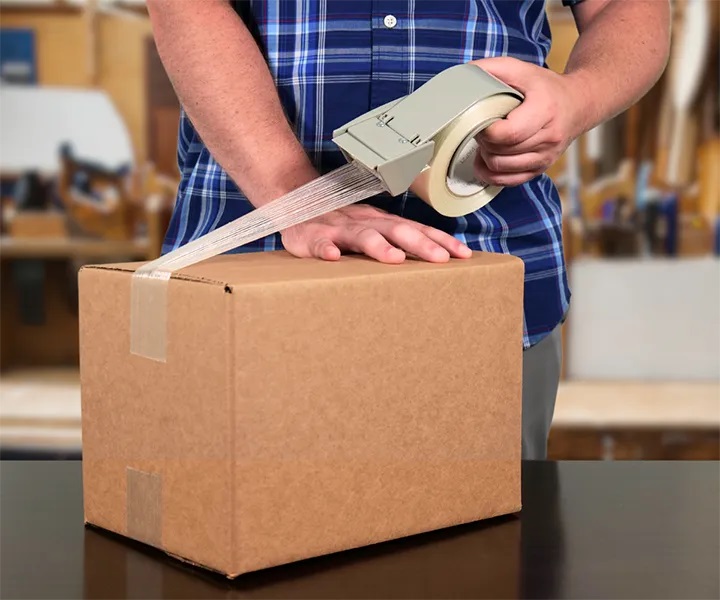
Mono filament strapping tape uses fiberglass reinforcement mainly in one direction. It is often the first option when the packaging force is mostly linear, such as carton reinforcement, edge protection, bundling, or transport securing.
We separate this range into two practical grades: Standard Grade and Heavy Duty Grade. They belong to the same mono filament strapping tape series, but they serve different load levels and cost targets.
Mono Filament Strapping Tape — Standard Grade is suitable for regular carton reinforcement and light-to-medium industrial bundling. It is a practical choice for high-volume packaging lines where the buyer needs stable reinforcement without over-engineering the package.
Typical applications include export carton edge reinforcement, warehouse bundling, light pipe or profile bundling, carton sealing reinforcement, and general transport securing.
We call it Standard Grade, but that does not mean weak. In many packaging lines, this is the workhorse. If the carton is not extremely heavy and the main force is in one direction, standard mono filament tape is usually the first product to test.
Mono Filament Strapping Tape — Heavy Duty Grade is used when regular mono tape is not enough. It is a stronger mono-directional option for heavier cartons, tougher bundling jobs, export packaging, long parts, and stronger transport securing.
This grade may reduce the need for metal or plastic strapping in selected applications, especially where local reinforcement or surface protection matters. But it should not be described as a complete steel strapping replacement. The final decision depends on product weight, carton strength, surface condition, transport method, storage conditions, and sample testing.
For sourcing teams, the real question is not simply “Which tape is strongest?” A better question is: “Which tape gives enough reinforcement without adding unnecessary material cost?”
Bi-Directional Filament Strapping Tape is reinforced in both the machine direction and cross direction. This structure helps when the package may face tearing, splitting, or shifting from more than one direction.
It is a better starting point for irregular packages, corner stress, rough handling, unstable loads, and packaging designs where one-direction reinforcement may not be enough. For example, if a carton edge may split sideways or a bundle may be pulled from different angles, bi-directional filament tape can provide safer reinforcement.
That does not mean every packaging line needs bi-directional tape. If the main force is linear and cost control matters, mono filament tape may still be the better choice. Bi-directional tape should be selected when the packaging risk justifies the higher material cost.
For a broader comparison of tape structures, adhesive systems, liners, and backing materials, visit our industrial tape material comparison guides. Material choice should support the actual packaging risk, not simply follow a stronger-is-better assumption.

Double Sided Filament Tape — Glassine Liner is not a strapping tape. It belongs to the secure fixing and reinforced bonding side of industrial packaging.
This tape is used when a buyer needs to fix foam pads, rubber strips, protective parts, spacers, buffer materials, or internal packaging components. The fiberglass reinforcement helps control stretch and improves dimensional stability compared with many ordinary double sided tapes.
Glassine liner is often a practical starting point for cost-sensitive bonding, manual application, semi-automatic use, and general converting jobs. It can be suitable when the buyer needs reinforced bonding with good handling and better cost control.
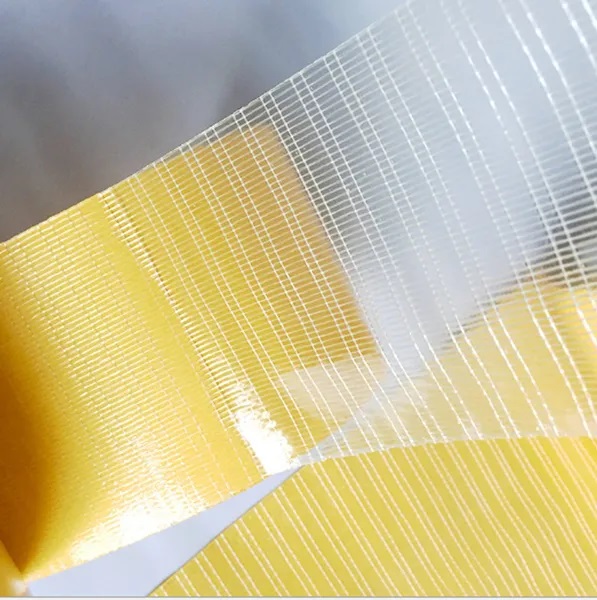
Double Sided Filament Tape — PET Film Liner is designed for applications where liner stability matters more. It is a better starting point for die-cutting, automated dispensing, long-roll processing, humid storage, or applications where liner tearing, curling, or dimensional variation may cause problems.
PET film liner should not be described simply as “better” than glassine liner. The real difference is process suitability. If the customer is doing regular manual bonding, glassine liner may be enough. If the customer needs cleaner converting, higher dimensional control, or more stable dispensing, PET film liner is often worth testing first.
For B2B buyers, the correct question is not only “Which liner is cheaper?” It is “Which liner works better with our application method, equipment tension, die-cutting process, and storage environment?”
Mono and bi-directional filament tapes solve different problems.
If the main force pulls in one direction, mono filament tape is usually more cost-effective. This includes many carton reinforcement, edge protection, and linear bundling applications. Within the mono series, Standard Grade is suitable for regular packaging, while Heavy Duty Grade is better for stronger holding and tougher loads.
If the package may tear or shift from different directions, bi-directional filament tape is the safer starting point. It is more suitable for irregular loads, corner stress, rough handling, and packaging designs where cross-direction splitting is a realistic risk.
A simple rule works well in many sourcing discussions: use mono filament tape when the load is mainly linear. Use bi-directional filament tape when the risk comes from multiple directions.
For double sided filament tape, the release liner is not a small detail. It affects handling, converting, die-cutting, dispensing, and storage stability.
|
Requirement |
Better Starting Point |
Note |
|
Cost-sensitive bonding |
Glassine liner |
Suitable for many regular bonding and converting jobs |
|
Manual or semi-automatic application |
Glassine liner |
Easy handling and economical |
|
Die-cutting with higher dimensional control |
PET film liner |
More stable for demanding converting |
|
Long-roll automated dispensing |
PET film liner |
Better when liner break or tension stability is a concern |
|
Humid storage or liner deformation concern |
PET film liner |
Usually safer when paper liner deformation is a known issue |
|
General foam or protective pad fixing |
Glassine or PET |
Choose by process and sample testing |
A low-cost liner that breaks during dispensing or shifts during die-cutting may cost more in downtime than it saves in material cost. On the other hand, using PET liner for every simple bonding job can also be unnecessary. The application process should decide the liner, not price alone.
Fiberglass reinforcement controls tensile strength and stretch. Adhesive chemistry controls how the tape grabs, holds, ages, and removes from the surface.
This is important because a tape with strong tensile data can still fail on the actual substrate. A carton coating, dusty surface, painted metal panel, plastic part, or foam material may all behave differently.
Most single sided filament strapping tapes, including Mono Filament Strapping Tape — Standard Grade, Mono Filament Strapping Tape — Heavy Duty Grade, and Bi-Directional Filament Strapping Tape, are typically based on rubber adhesive systems.
This adhesive direction is often selected for fast initial tack, practical bonding on cartons, and good handling in regular packaging lines. It is a useful platform for carton reinforcement, bundling, and transport securing.
But rubber adhesive should not be treated as a universal answer. If the tape will face high heat, long storage, outdoor exposure, or clean removal requirements, the actual surface and storage conditions must be tested.
For double sided filament tape, adhesive selection depends on liner type, bonding requirement, and processing method. In some PET film liner versions, acrylic adhesive may be used when better aging resistance, cleaner converting, or more stable bonding performance is required.
This does not mean acrylic is always better than rubber adhesive. Different adhesive systems have different tack, holding power, removability, and aging behavior. The final choice should follow the actual TDS and customer application test.
If the tape must be removed after transport, especially from painted metal, glossy plastic, stainless steel, appliance panels, or other visible surfaces, do not assume that a general packaging-grade rubber adhesive will remove cleanly.
For these jobs, clean removal, staining risk, and coating compatibility should be tested on the actual surface after realistic storage and transport conditions. If a low-residue version is required, it should be discussed as a separate technical requirement instead of assuming that every packaging tape can do it.
Avoid absolute claims such as “residue-free” or “clean removal guaranteed” unless the tape has been tested under the buyer’s actual conditions.
Tape width changes more than appearance. A wider tape gives a larger bonding area and usually provides more total reinforcement, but it also increases material cost.
For carton edge reinforcement, a narrower tape may be enough. For heavier cartons, long bundles, rough handling, or wider stress areas, a wider tape or stronger grade may be safer. The surface strength also matters. In some cases, the carton surface may tear before the tape itself reaches its tensile limit.
This is why width should be selected together with tape grade, carton strength, application position, and transport risk.
Export cartons often face repeated handling, stacking pressure, vibration, and long storage time. Filament tape can reinforce carton edges, sealing areas, and stress points where ordinary packing tape may not be strong enough.
For regular reinforcement, Standard Grade mono filament tape is usually the first option. For heavier cartons or tougher shipping conditions, Heavy Duty Grade may be a better starting point. If the carton may split from different directions, bi-directional filament tape should be considered.
Pallet packaging usually relies on a combination of materials, such as stretch film, corner boards, straps, and tape. Filament tape can support local reinforcement, top securing, bundling, and movement control.
Heavy Duty Grade and Bi-Directional Filament Strapping Tape are more suitable when the pallet load is unstable or when the package faces rough handling. Still, filament tape should be used as part of the packaging design, not as a blind replacement for all pallet securing materials.
Pipes, tubes, rods, and profiles often create linear load conditions. This is where mono filament tape performs well. Standard Grade can be used for regular bundling, while Heavy Duty Grade is better for heavier or more demanding loads.
For long items, tape width, overlap, surface condition, and pulling direction all matter. Buyers should test not only the initial holding force, but also whether the bundle stays tight after storage and handling.
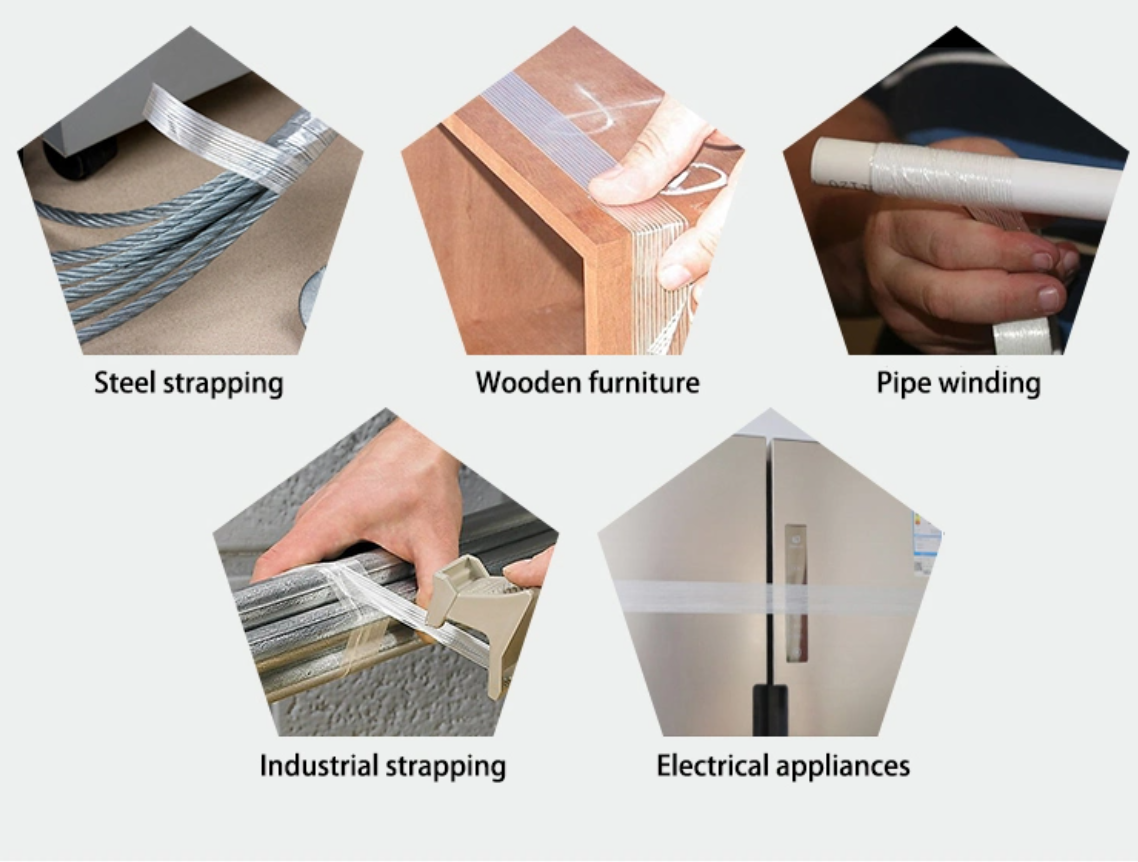
Appliance packaging has a different risk profile. A tape may need to hold cartons, internal packaging parts, foam pads, or non-visible components during transport. For outer carton reinforcement or non-visible packaging areas, Heavy Duty Grade or Bi-Directional Filament Strapping Tape may be considered.
If the tape will touch painted panels, glossy plastic, stainless steel, or any visible appliance surface, standard packaging-grade filament tape should not be assumed suitable. Clean removal, staining risk, and coating compatibility must be tested on the actual surface.
For internal protective parts, foam pads, rubber buffers, or spacers, Double Sided Filament Tape may be more suitable than single sided strapping tape.
Foam pads, rubber strips, protective liners, and buffer parts can shift during packaging, storage, or transport. Double Sided Filament Tape helps provide reinforced bonding and better dimensional stability for these parts.
Glassine liner is often practical for regular bonding and cost-sensitive use. PET film liner is better when the buyer needs stronger liner handling, die-cutting stability, humid storage resistance, or automated dispensing stability.
For broader topic navigation, you can also visit our industrial tape buying guides, material comparison guides, failure analysis guides, and technical guides.
How to Choose the Right Filament Tape for Bundling, Palletizing, and Transport Securing
Filament Tape Failure and Selection for Heavy-Duty Packaging
Standard vs Heavy Duty Mono Filament Tape: When to Upgrade
Filament Tape for Carton Reinforcement | Prevent Box Failure