
info@jxgreentape.com
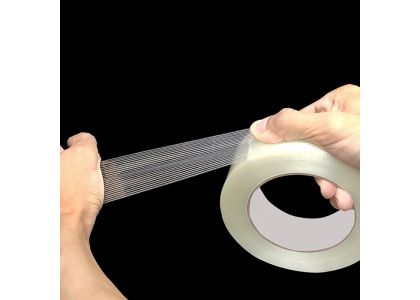
For industrial buyers, specifying tape is a technical decision that affects product protection, claims, and line efficiency. This article explains how to create actionable filament tape spec requirements, how to interpret key numbers, and how to evaluate tape performance in both pallet strapping and wire harness applications. You will find industry reference ranges, test-method guidance, and a practical procurement/QA checklist you can drop into purchase orders and supplier contracts.
When your plant ships hundreds or thousands of pallets and assembles thousands of harnesses, tape choice is not a simple consumable decision. The right tape prevents load shift, reduces rework, and lowers the total cost of ownership. A formal filament tape spec that includes backing strength, adhesive metrics, and environmental limits reduces disputes with suppliers and gives QA teams measurable acceptance criteria.
Any robust filament tape spec addresses three metric families:
Mechanical: filament tape tensile strength, elongation at break, tear propagation resistance.
Adhesive: peel adhesion, shear holding power, initial tack on your substrates.
Environmental: operating temperature range, humidity tolerance, UV stability.
Secondary but important items: roll dimensions, cord density, and lamination quality (edge encapsulation). A complete spec ties each metric to an ASTM or ISO test method and to the actual substrate you use on the floor.
Use these conservative, industry-proven ranges as starting gates when evaluating samples or writing specs:
Tensile strength (backing + cords): 100–600 N/25 mm (≈90–550 lbs/in). Heavy export grades typically sit at the upper end.
Elongation at break: 3%–12% (3%–8% typical for pallet strapping; 5%–12% for harness uses).
Peel adhesion (steel): ~25–60 oz/in (≈2.7–6.5 N/25 mm). Test on your corrugate for pallet work.
Temperature (working): –20 °C to +80 °C typical; specialty adhesives/backings extend short-term limits.
Typical roll sizes when buying bulk: widths 12–48 mm, lengths 25–100 m.
These are reference values. Always require supplier Technical Data Sheets (TDS) and Certificate of Analysis (COA) for lot-specific numbers.
filament tape tensile strength is the headline figure, but it must be specified precisely:
Specify the test standard (e.g., ASTM D3759 or equivalent). Test method matters.
Define preconditioning (for example: 24 hours at 23 °C / 50% RH). Different conditioning yields different results.
Request units and conversions on the TDS (state if you want N/25 mm or lb/in). Conversion: 1 lb/in ≈ 175.126 N/25 mm.
State acceptance criteria: e.g., “Minimum filament tape tensile strength 300 N/25 mm (ASTM D3759).”
Ask whether the vendor reports peak tensile or tensile modulus; for load retention, require peak tensile (force at break).
Also consider cord density and composition (fiberglass yarn count per cm). Two tapes with equal nominal tensile may behave differently in practice if one has denser yarn or a stiffer film.
Adhesive performance is as important as backing strength. A typical filament tape spec should include:
Peel adhesion (ASTM D3330): initial grab and peel strength on the actual substrate (corrugate, plastic, or metal).
Shear holding power (ASTM D3654): predicts long-dwell performance such as pallets stored in containers.
Tack: user-perceived instant grab during application.
Match adhesive chemistry to your environment:
Rubber-based adhesives: high initial tack, good for dusty corrugate; limited heat resistance.
Synthetic/hot-melt adhesives: balance of tack and temperature performance.
Acrylics: better humidity and UV resistance, more stable for long-term storage.
Always request peel values on your actual boxstock or cable jacket. A supplier’s steel-peel number tells only part of the story.
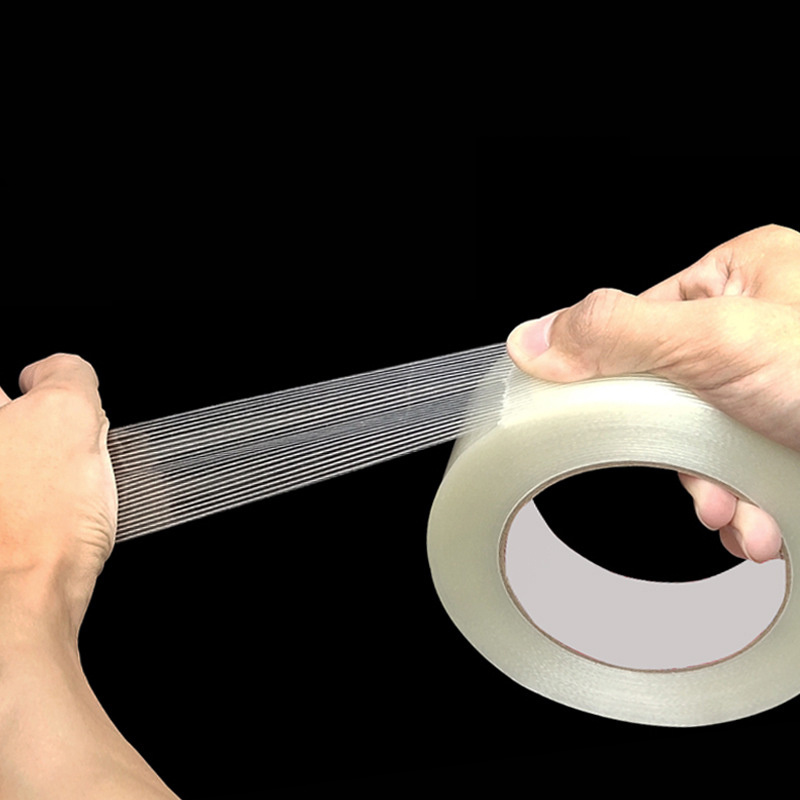
Low elongation is generally preferred for pallet strapping since stretch can allow load movement. For harnesses, controlled elongation (5%–12%) helps absorb vibration. Additional metrics to specify:
Tear propagation resistance: prevents rapid failure from a nick.
Edge fray resistance: ensures cords remain encapsulated and do not snag on machinery.
Conformability: the ability to follow corners without tenting.
Test both in the lab and in dynamic field trials: vibration tables, drop tests, and container-stowage evaluations reveal failure modes that static lab tests can miss.
A robust filament tape spec (and associated vendor paperwork) should provide:
Product name, manufacturer and lot/batch code.
Backing and reinforcement description (material, yarn count, orientation).
Measured values: tensile, elongation, peel, shear, thickness, temperature range.
Test methods and conditioning details (e.g., ASTM references).
Batch-level COA showing measured values for the production lot.
Include TDS and COA in your purchase order. If a supplier hesitates to provide lot COAs, treat it as a red flag.
Buying bulk filament tape reduces unit cost but increases lot exposure. Mitigate risk by:
Negotiating COA and sampling terms in the contract.
Maintaining a 1% incoming-sample program for lab verification (tensile, peel, shear).
Storing rolls in controlled conditions (humidity and temperature control).
Requiring barcoded lot labels and traceability.
Bulk buys are effective only when paired with robust QA and supplier accountability.
Pallet strapping: prioritize high filament tape tensile strength (e.g., 250–450 N/25 mm), low elongation (≤6%), high shear, and peel ≥30 oz/in on corrugate. Validate with vibration and container-stowage tests.
Wire harness bundling: prioritize flexibility, abrasion resistance, controlled elongation (5%–12%), and adhesives compatible with PVC, rubber, or Teflon jacketing. Also check for dielectric compatibility if tape will be used near exposed terminals.
Many manufacturers keep two SKUs: one optimized for pallet work and another tuned for harness assembly. Label and train operators on correct use cases.
Before approving a new tape SKU:
Require TDS and COA with ASTM method references.
Pull a 1% incoming sample for lab tests (ASTM D3759, D3330, D3654).
Run a 30–90 day field trial (100 pallets; 500 harnesses). Log failures by SKU, line, and shift.
Verify shelf-life and storage instructions.
Include contractual replacement and corrective-action clauses for non-conforming lots.
This checklist converts vendor claims into measurable acceptance criteria.
The numeric ranges and test-method references in this article are industry reference values intended to guide specification writing and supplier evaluation. Actual performance depends on formulation, cord density, lamination, and production lot. To ensure accuracy:
Require TDS and COA per lot and make them part of the purchase order.
Perform in-house or third-party verification on representative samples (e.g., ASTM D3759 for tensile, ASTM D3330 for peel, ASTM D3654 for shear).
Conduct field trials (sample pallets and harnesses) to capture real-world failure and rework data (30–90 days typical).
Document results and use them to drive supplier corrective actions and acceptance decisions.
Documented verification and supplier accountability reduce claims, lower rework, and make your filament tape spec enforceable.
Create two separate, tested specs: one for Filament Tape for Pallet Strapping (high tensile, low elongation) and one for harnessing.
Use the industry ranges above as starting gates and always reference ASTM methods.
Buy bulk filament tape only with agreed sampling, COA, and traceability.
Run lab and field trials before full-scale adoption.
Track KPIs: failures per 1,000 pallets, rework hours, and tape spend per load — iterate quarterly.
A disciplined, data-driven approach reduces claims, improves uptime, and turns tape selection from guesswork into a measurable part of your cost and quality system.
Author: Jarod, Material Manager, Jiaxing Risure New Material Co., Ltd.
Jarod manages adhesive specifications, supplier quality, and product validation for B2B adhesive solutions.