
info@jxgreentape.com

In 2026, the biggest change in filament strapping tape is not a miracle material or a flashy new claim. The real shift is that more buyers are no longer satisfied with labels like “strong,” “heavy duty,” or “high tack.” They want to know whether a tape performs consistently on the cartons they actually use, under the route conditions they actually ship through.
That matters because packaging conditions are getting less forgiving. Recycled corrugated board is more variable, line speeds are higher, and handling intensity is up. Under those conditions, the wrong tape does not always fail in an obvious way. It often fails quietly: edge lift after staging, poor laydown on dusty corrugate, uneven unwind on a dispenser, or seam weakness that only shows up after a temperature change.
So the smarter buying question is no longer, “Which tape has the highest headline strength?” It is, “Which tape stays stable across variable cartons, operators, temperatures, and shipping routes?”
That is a much better procurement standard. It also fits how packaging tapes are actually specified and tested in industry. ASTM D5330 covers filament-reinforced pressure-sensitive tape for packaging and places these tapes in the context of closing and reinforcing fiberboard boxes and bundling items for shipment.
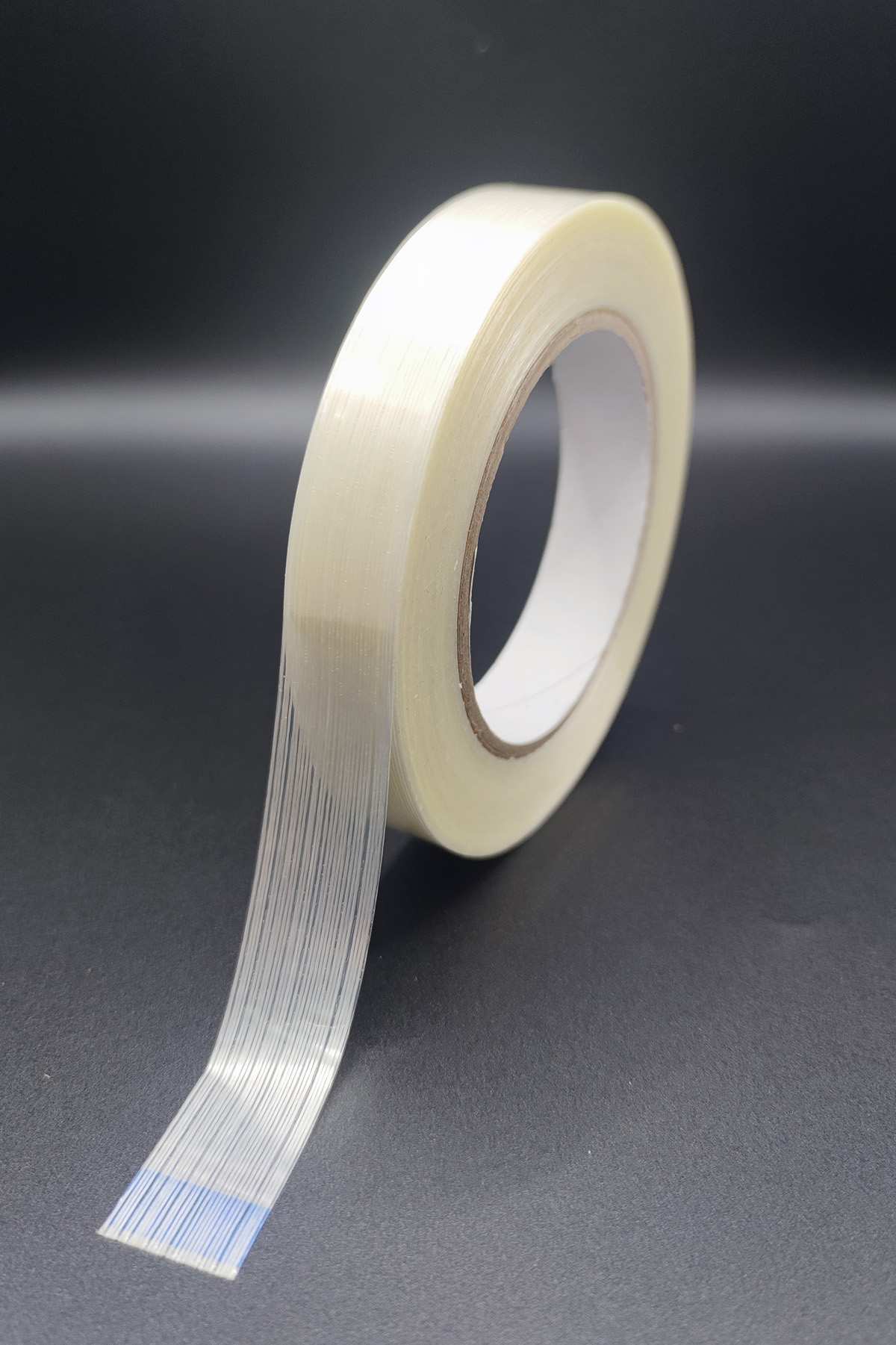
Filament tape still comes down to the same basic building blocks: a film backing, fiberglass reinforcement, and a pressure-sensitive adhesive. What is changing is how suppliers tune those layers for real packaging failure modes instead of just chasing bigger numbers on a datasheet.
One useful shift is more attention to reinforcement layout. In practice, yarn spacing, yarn pattern, and backing stability can matter as much as the general claim of “reinforced.” A tape that looks impressive on paper may still underperform if it does not sit flat, wrinkles under tension, or loses bond at the edges on variable corrugated surfaces.
Adhesive selection is where buyers often feel the biggest real-world difference.
Some products are tuned for recycled corrugate and fiber variation. Others are better suited to faster line application or more controlled warehouse conditions. That is why it helps to stop asking for “high tack” in the abstract and instead describe the substrate, carton grade, handling style, and route profile.
This is also where test language matters. If your cartons vary, it is not enough to compare one peel value on steel. ASTM D2860 is specifically designed to measure the adhesion of pressure-sensitive tape to fiberboard under constant stress, which is much closer to real corrugated-carton decision making than a generic lab comparison on metal.
The practical takeaway is simple: buyers should look less at maximum-claim marketing and more at construction balance. The best-performing tape in a real packaging program is often the one that keeps bond, shape, and application behavior stable across messy operating conditions.
Heavy-duty filament tape still matters, but the definition of “better” is becoming more realistic. In actual packaging operations, a strong tape has to survive more than a one-time pull. It needs to tolerate corner stress, repeated handling, vibration, and tension shifts over time.
That is why the most useful improvements often show up in holding performance, tear resistance at stress points, and better behavior around carton edges. A small edge lift can become a much larger failure after transfer, pallet movement, or stretch-wrap interaction. Buyers who only compare maximum tensile values often miss that.
ASTM D3759 remains relevant when comparing breaking strength and elongation of heavy-duty grades. But it should not be the only number in the room. For packaging programs that fail under sustained stress rather than instant pull, shear holding ability matters too. ASTM D3654 is more relevant when the real question is creep, holding power, or stability under constant load.
There is also a productivity angle buyers sometimes underestimate. If a heavy-duty tape dispenses poorly, curls, or forces operators to add extra wraps just to feel safe, the total cost goes up even if the roll price looks competitive. That is why procurement should evaluate heavy-duty tape not only on strength, but also on application consistency and operator behavior.
A lot of “customization” talk in packaging is fluff. A printed logo may help branding, but it does not solve line-side problems. For most B2B packaging teams, the useful part of customization is narrower and more practical:
· roll consistency
· unwind stability
· clean release from dispensers
· predictable bond at application speed
· dimensions that stay under control
If you run semi-automated or automated lines, machine compatibility is not a side issue. It is part of product performance. A tape that works acceptably by hand can still create trouble on a faster line if unwind is jerky, if roll geometry drifts, or if the backing tends to curl after application.
This is where buyers should separate cosmetic options from process-critical ones. Ask whether the supplier can hold stable roll quality over time. Ask how they manage variation between production lots. Ask what application range they recommend instead of assuming every reinforced tape will behave the same in every dispenser or line setup.
Right-sizing is another underused lever. In many programs, savings come not from buying the cheapest tape but from matching construction to the real packaging job so operators stop over-applying. One better-tuned tape can reduce extra wraps, rework, and damage claims more effectively than aggressive unit-price negotiation.
Shipping is where weak tape programs get exposed. More transfers, more mixed handling conditions, more recycled cartons, and wider temperature swings all increase the penalty for poor consistency.
Cold-start performance is one of the clearest examples. A tape may look fine in a warm packing area and still disappoint after cartons move into a colder environment or pass through temperature transitions. ASTM D3889 specifically addresses adherence of pressure-sensitive tape to linerboard at low temperature, which makes it highly relevant when buyers are trying to understand winter-route failures or cold-storage staging issues.
For export packaging, the practical validation sequence does not need to be complicated. Apply the tape on representative cartons. Let it dwell under realistic staging conditions. Then recheck seam integrity after the temperature or handling transitions that actually create trouble in your network.
That kind of validation is far more useful than relying only on one-room laboratory claims.
Sustainability is also part of the conversation, but the practical gain in many operations comes from using less tape through better consistency, not from vague green claims. If operators stop doubling up, and if repacks and transit damage fall, total packaging waste usually improves as well.
A distributor shipping mixed industrial accessories had an irritating problem: carton seams were not failing everywhere, only on certain routes. The pattern looked random until the team compared staging conditions and carton batches more carefully.
Their first response was typical. They used more tape and larger overlaps. That reduced obvious failures for a while, but it also slowed packing and pushed material use higher.
The better fix came when they stopped treating every reinforcement job as the same job.
First, they separated seam reinforcement from product bundling. One construction was used for carton seam integrity, while another was used only where grouped items needed stabilization inside the broader packaging process.
Second, they tested on the actual corrugated board used in production instead of relying on generic supplier claims. That matters because fiberboard adhesion can be the limiting factor long before reinforcement itself becomes the problem. ASTM D2860 is directly relevant here because it focuses on adhesion to fiberboard under stress.
Third, they tracked lot identity and application feedback. That helped them see whether the problem was the route, the carton, operator habit, or a shift in tape consistency.
The result was not dramatic marketing language. It was something more useful: fewer mystery failures, less over-application, and a packaging process that stayed stable when route conditions changed.
When two filament tape options look similar, long-term performance usually comes down to control, not brochure language.
In RFQs and qualification reviews, buyers should ask for:
· construction type and intended use case, not just a sales label
· adhesion data relevant to corrugated or fiberboard performance
· guidance for application method, line speed, and overlap practice
· lot traceability and consistency controls
· expected behavior across temperature range, especially if cold exposure matters
· unwind and handling recommendations for manual vs semi-automated use
· lead-time and supply continuity for program SKUs
If the supplier can only talk in broad terms like “stronger,” “premium,” or “better adhesion,” that is not enough. A strong supplier should be able to explain what is being controlled, what is being tested, and what conditions the tape is meant to handle.
That is the real buying standard in 2026: not who makes the loudest performance claim, but who can support repeatable packaging performance across changing real-world conditions.
Q1. How should buyers compare heavy-duty filament tape options?
Do not compare only one tensile value. Compare strength, holding behavior, fiberboard adhesion, and application consistency together. Heavy-duty grades that look similar on paper can perform very differently on real cartons.
Q2. Why does filament tape sometimes fail on recycled corrugated cartons?
Because the weak point is often the bond to the carton surface, not the fiberglass reinforcement. Recycled corrugate can vary in dust, surface fiber condition, and liner quality, which changes adhesive performance.
Q3. What tests matter most before switching suppliers?
For this topic, ASTM D5330 is useful for product category and intended packaging use; ASTM D2860 helps for adhesion to fiberboard; ASTM D3654 helps for shear holding behavior; ASTM D3889 matters if low-temperature performance is a concern; and ASTM D3759 is relevant for breaking strength and elongation.
Q4. Can buyers lower packaging cost without moving to a cheaper tape?
Yes. In many operations, the bigger savings come from reducing over-application, rework, and transport failures. A better-matched tape can lower total packaging cost even when the roll price is not the lowest.
Q5. What should procurement include in an RFQ?
Include carton type, surface variability, application method, route temperature exposure, need for lot traceability, and any issues with line speed or unwind behavior. Generic RFQs create generic answers.
The following standards are the most relevant support points for this topic: