
info@jxgreentape.com
Final Thoughts
When a molded part sticks, it is tempting to blame the release surface immediately. In real production, the problem is often more complicated. Resin may build up near mold edges. Tape may lift during cure. A polished part may show witness marks. A rough tooling area may wear through a thin film faster than expected. Sometimes the release layer works for one trial run, then fails after several cycles.
That is why choosing PTFE release tape for mold release should not start with “which tape is most non-stick?” A better question is: what failure are you trying to prevent?
A flat mold plate, a curved composite tool, a resin-heavy hand lay-up area, and a heated press surface do not need the same tape structure. Surface finish, mold shape, resin chemistry, adhesive type, pressure, temperature, and expected cycle life all change the decision.
This guide is written for buyers and engineers who need a practical starting point. PTFE film tape, PTFE glass cloth tape, and skived PTFE tape can all be considered in mold release work, but they do not carry the same role. Film and glass cloth tapes are more straightforward release-tape choices. Skived PTFE tape can be useful in selected cases, but it should be treated as a validation candidate, not an automatic upgrade.
PTFE tape is used because it creates a physical release layer between the resin, adhesive, or bonding material and the tooling surface. Instead of allowing resin to contact the mold directly, the PTFE surface helps reduce sticking and makes cleaning easier after the cycle.
In many shops, the tape is not used across the entire mold. It is applied only where problems happen: mold flanges, resin overflow zones, work surfaces, guide areas, vacuum bagging support areas, or tooling edges that collect cured resin. This is often more practical than covering a large mold face unnecessarily.
The value is also not limited to release. PTFE tape can protect the tooling surface, reduce scraping, shorten clean-up time, and make small process zones more repeatable. But it should not be described as a universal replacement for chemical mold release agents. In composite molding, release performance usually depends on a system: mold preparation, cleaning, tape surface, resin type, cure schedule, pressure, and operator handling.
A good tape can help. A poor application on a dirty mold surface can still fail.
In composite molding, PTFE tape for mold release is often used on selected tooling surfaces, mold edges, flange areas, and resin contact zones. In hand lay-up and open mold processing, it may protect benches, trim areas, temporary fixtures, and fabrication tables where operators need a cleaner working surface.
For vacuum bagging support areas, the tape may be used around zones where resin bleed, tacky materials, or repeated bagging work create cleaning problems. It may also help around edges where operators need temporary protection rather than a permanent tooling change.
In heated pressing or bonding work, PTFE release tape may be applied to plates, guides, bars, or contact areas where resin, adhesive, or composite materials need to separate cleanly after pressure and heat.
The key is not to ask, “Can PTFE tape be used on molds?” It can. The better question is, “Which part of the mold creates the problem?” If the issue is surface appearance, choose for smoothness. If the issue is wear, choose for reinforcement. If the issue is edge lifting, look at adhesive, surface preparation, and tape layout.
PTFE film tape is usually the first candidate when a smoother release surface matters. Its surface is generally flatter than a woven glass cloth tape, so it may be better suited to visible areas, flat tooling plates, low-friction guide surfaces, and short trial runs where texture transfer is a concern.
This does not mean film tape automatically creates a perfect molded finish. Seam placement, trapped air, adhesive behavior, tape thickness, and application skill still matter. But when compared with reinforced woven backing, PTFE film tape has a clearer role in applications where the buyer wants a cleaner, smoother contact surface.
The limitation is durability. Thin film tape may tear, wrinkle, puncture, or wear faster under repeated abrasion. Edges can also become weak points, especially if the mold has steps, corners, resin-rich zones, or frequent operator handling.
When comparing film tapes, ask for total thickness, PTFE backing thickness, adhesive type, peel adhesion, tensile strength, and elongation. Some supplier datasheets report these values using test methods such as ASTM D3330 for peel adhesion, ASTM D3652 for thickness, and ASTM D3759 for tensile strength and elongation. These numbers do not choose the tape for you, but they help you compare candidates more intelligently.
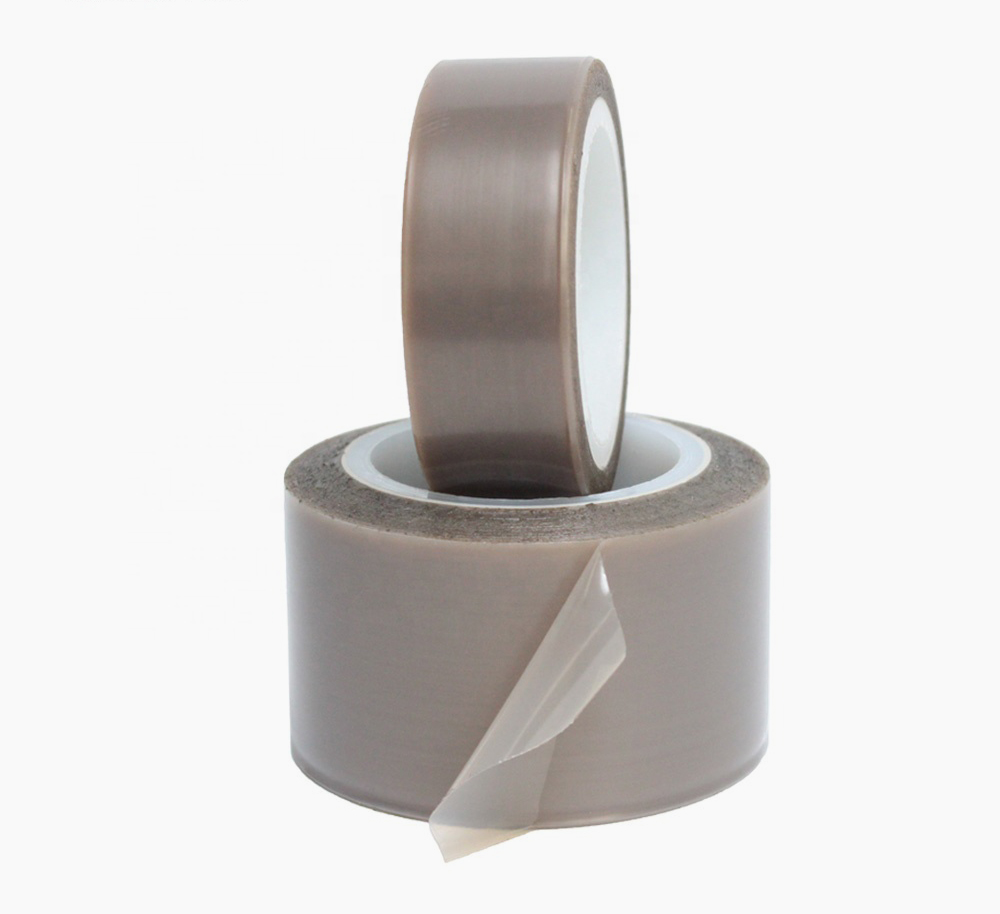
PTFE glass cloth tape for molds makes sense when the release surface needs more mechanical strength. The woven glass fabric backing gives the tape better resistance to tearing and handling damage than many thin film tapes. That matters on mold edges, rougher tooling surfaces, repeated wiping areas, resin overflow zones, and fabrication tables.
This type of tape is often a practical choice when durability is more important than a perfectly smooth surface. If operators are cleaning, pressing, sliding parts, trimming nearby, or repeating the same process many times, a reinforced PTFE glass cloth tape may survive better than a thin PTFE film tape.
The trade-off is surface texture. Because the backing is woven, it may leave a slight fabric pattern or create visible witness marks under certain conditions. For non-cosmetic tooling protection, that may be acceptable. For high-gloss composite parts, visible molded surfaces, or optical-quality finishes, it should be tested before production use.
Do not order only by the phrase “PTFE glass cloth tape.” Coating weight, fabric grade, total thickness, adhesive type, edge quality, and surface smoothness all affect performance. Two tapes with the same general name can behave very differently on the mold.
Skived PTFE tape deserves a place in this discussion, but it should be positioned carefully. It is not being included just to fill a comparison table. Skived PTFE tapes are used in industrial release, low-friction, and composite tooling-related applications. However, for mold release selection, they should not be presented as the default best choice.
The reason buyers consider skived PTFE tape is usually its combination of a smoother PTFE surface and a thicker PTFE layer than some thin film tapes. In selected applications, that may help when the process needs low friction, more PTFE wear allowance, or reduced risk of woven texture compared with glass cloth tape.
It may be considered for flat or moderately shaped tooling areas, bonding fixtures, guide surfaces, press contact zones, and selected mold release areas where the buyer wants a more substantial PTFE surface. But “thicker” does not automatically mean “better.” A thicker tape may be harder to conform around tight curves. It may also create a more visible edge or seam if the part surface is sensitive.
The correct approach is to test it under the real resin system, pressure, temperature, and cure cycle. Skived PTFE tape can be a good candidate, but it still has to prove itself on the actual mold.
The PTFE surface gets most of the attention, but the adhesive side can decide whether the tape works in production. Many adhesive-backed PTFE tapes use silicone pressure-sensitive adhesive because it can handle demanding temperature conditions. Some PTFE tapes are also available with acrylic adhesive or other adhesive systems, depending on the grade and supplier.
For mold release, the adhesive should be checked as seriously as the PTFE backing. A tape may release well on the top surface but still fail if the adhesive softens, creeps, leaves residue, or lifts at the edge during the curing cycle. Heated tooling, vacuum bagging support areas, mold flanges, and resin-rich edges make this more important.
There is also a downstream concern. If the molded part will be painted, bonded, coated, laminated, or used in a surface-sensitive assembly, ask whether the adhesive system may create residue or contamination risk under your process. This does not mean every silicone adhesive is a problem. That would be an overstatement. It means the risk should be checked before production approval.
A practical sample test should include tape application, full cure exposure, tape removal, tooling inspection, molded part inspection, and any required downstream painting or bonding check. If the tape passes release but leaves residue that affects the next process, it has not really passed.
Heat changes the selection. During heated molding cycles, the tape may face expansion, pressure, resin contact, adhesive softening, cooling stress, and repeated handling. If the tape defines a boundary line or protects a visible edge, even small movement can create a quality issue.
This is why buyers should ask for dimensional stability, shrinkage behavior, recommended temperature range, and adhesive performance after heat exposure. Do not assume that skived PTFE tape, PTFE film tape, or glass cloth tape will always stay stable just because the PTFE surface has good thermal resistance.
The tape is a structure: PTFE layer, backing, adhesive, liner, thickness, and applied tension all matter. A tape stretched during installation may behave differently after heat exposure. A tape that looks flat at room temperature may lift at the edge after one cure cycle.
For heated press, autoclave, oven, or hot tooling work, always test the tape through the full cycle before approving it for repeated production.
This is the real selection question.
A simple rule works well: choose for the failure mode. Sticking points to release surface and resin compatibility. Wear points to backing strength. Surface marks point to texture and seams. Edge lift points to adhesive, cleaning, and overlap design.
The first mistake is choosing only by maximum temperature. Temperature resistance matters, but it does not explain surface finish, adhesive residue, abrasion resistance, conformability, or resin compatibility.
The second mistake is ignoring resin behavior. Epoxy, polyester, vinyl ester, phenolic, silicone rubber, and other systems may behave differently during cure and release. A tape that works in one process may disappoint in another.
A third mistake is applying tape to a dirty mold. Dust, wax residue, oil, moisture, old resin, and release-agent build-up can weaken adhesion. If the tape lifts, the problem may be surface preparation, not tape quality.
Another common problem is poor seam and overlap design. Bad overlaps can trap resin, create ridges, leave witness marks, or become starting points for edge lifting. On visible surfaces, seam placement should be planned before production.
Finally, some buyers skip sample validation. That is risky. A small trial can reveal release behavior, edge stability, surface marking, residue, and actual cycle life before a full batch is affected.
|
Application condition |
Practical starting point |
Parameter focus |
What to verify |
|
High-gloss visible surface |
PTFE film tape or skived PTFE tape |
Smooth surface, low texture risk, controlled thickness |
Witness marks, seam lines, surface finish |
|
High abrasion area |
PTFE glass cloth tape |
Reinforced backing, tensile strength, wear resistance |
Texture transfer, edge wear, replacement interval |
|
Curved tooling |
Conformable PTFE film or skived PTFE candidate |
Elongation, total thickness, application behavior |
Wrinkles, trapped air, edge lift |
|
Short trial run |
PTFE film tape |
Easy application, clean removal, moderate thickness |
Release result and adhesive residue |
|
Repeated cycles |
PTFE glass cloth tape or validated skived PTFE tape |
Backing durability, adhesive stability, heat behavior |
Actual cycle life under production conditions |
|
Resin-heavy process |
Thicker PTFE or reinforced PTFE option |
Resin contact area, edge protection, overlap design |
Resin seepage and cleaning interval |
|
Parts requiring painting or bonding |
Low-residue or suitable adhesive system |
Adhesive chemistry, residue risk, supplier data |
Paintability, bonding result, surface cleanliness |
This table is not a final answer. It is a starting point for sample selection. The correct tape is the one that survives your mold, your resin, your heat cycle, and your quality standard.
A useful inquiry should include more than width and quantity.
Tell the supplier your resin type, curing temperature, pressure, contact time, and process method. Is it hand lay-up, vacuum bagging, heated press, oven cure, open mold processing, or bonding fixture work? Explain whether the tape will touch a visible part surface or only protect a tooling edge.
Describe the mold geometry. Is the surface flat, slightly curved, tightly contoured, or full of corners and steps? A tape that works on a flat coupon may fail on a tight radius.
Clarify expected cycle life. Is this for a one-time trial, short production run, or repeated use? Also confirm whether you need adhesive-backed tape or non-adhesive PTFE material. Adhesive-backed tape is convenient, but the adhesive becomes part of the performance system.
Ask for samples and datasheets. At minimum, request adhesive type, total thickness, backing thickness, recommended temperature range, peel adhesion, tensile strength, elongation, and any available dimensional stability information. Then test the tape on your actual mold before approving it.
Choosing PTFE release tape for mold release is not about finding the most slippery tape on paper. It is about matching the tape structure to the real production problem.
PTFE film tape is useful when a smoother release surface matters. PTFE glass cloth tape is often better when the tape needs to survive abrasion, handling, and repeated cycles. Skived PTFE tape is a valid candidate when a thicker PTFE layer and smooth low-friction surface may help, but it should be tested rather than assumed to be superior.
For composite molding release, the best decision comes from a controlled sample trial: real mold, real resin, real temperature, real pressure, and real inspection criteria. That is how buyers avoid guessing and choose a tape that actually works in production.
Is PTFE release tape the same as a chemical mold release agent?
No. PTFE release tape works as a physical release surface, while chemical mold release agents are applied coatings or films. In some processes, both may be used in different areas, but one should not automatically be treated as a full replacement for the other.
Which PTFE tape is better for high-gloss molded parts?
PTFE film tape or skived PTFE tape may be better starting points because they usually offer a smoother contact surface than woven glass cloth tape. However, high-gloss parts should always be tested for witness marks, seams, and surface transfer.
Can PTFE glass cloth tape be used on composite molds?
Yes. PTFE glass cloth tape can be used for mold edges, tooling protection, work surfaces, and selected release areas where durability matters. But because it has a woven backing, it should be tested before use on visible high-finish surfaces.
Does silicone adhesive cause contamination on composite parts?
It can be a concern in some painting, coating, or bonding processes, but it is not an automatic failure. Buyers should confirm adhesive chemistry, run a process trial, and inspect both the molded part and downstream bonding or coating result.
Can PTFE release tape withstand heated curing cycles?
Some PTFE tapes are designed for high-temperature service, but ratings are product-specific. Buyers should verify adhesive stability, dimensional movement, shrinkage, edge lift, and removal behavior after the full curing cycle, not just check the PTFE temperature rating.
What should I send when requesting a mold release tape sample?
Send resin type, curing temperature, pressure, mold surface finish, mold geometry, expected cycle life, required thickness, tape width, and whether adhesive-backed or non-adhesive material is needed. This helps the supplier recommend a more realistic starting sample.