
info@jxgreentape.com
Automotive interior harness sections are wrapped to retain branch geometry, cushion contact with surrounding trim, or protect a local area from rubbing. The right wrap depends on each section's job. Start with the installation zone and the job, then confirm the material, wrapping pattern and finished-harness performance under the conditions your drawing requires.
Discuss Your Application Compare Tape Grades
Branches sit close together on an instrument-panel harness, and the route changes direction often. The wrap has to hold that geometry. Stiffen the bundle too much and branches end up out of position, so the harness fights its intended route during fitting. The other recurring issue here is contact with trim, where a softer covering cushions the bundle. W532 for flexible, noise-damping wraps; W531a where hand-tearable bundling is enough.
Door-trim harnesses routed on the dry side of the moisture barrier, behind the trim panel serve switches and interior lighting. Behind the trim, the loom needs organized routing and soft coverage at contact points. Evaluate W532 where cushioning and contact-noise control are priorities, or W531a for general manual bundling. This scope excludes the wet zone and hinge transition.
Wrapping tape covers the cable bundle; it does not attach the harness to the headliner. Near a headliner, a flexible, low-bulk wrap keeps wires together and reduces noise where the bundle touches nearby interior parts. The selected pattern preserves the geometry needed for installation in limited space, while mounting uses a separately specified fastening or cable-mounting solution.
Even behind the same trunk trim or interior body panel, different harness sections have different wrapping tasks. Some sections need nothing beyond general bundling, while contact points and localized rubbing areas ask more of the wrap. Evaluate W532 where soft coverage and contact-noise control are required; consider W531b (not hand tearable) only where higher mechanical protection is required and its application can be accommodated.
One harness contains several wrapping jobs. One branch needs to remain flexible, another section touches a trim panel, and a short area passes a bracket or edge. Defining separate wrapping zones states what each section must achieve and avoids unnecessary thickness or stiffness elsewhere.
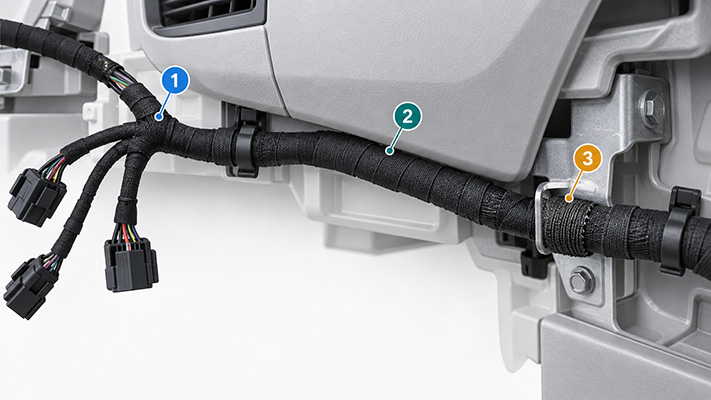
Illustrative wrapping zones. Harness mounting uses the clips and brackets shown; the tape covers the bundle.
Compare our wire harness tape grades side by side.
Spot wrapping places short bands at selected positions to hold wires together or cover a defined contact area, using less material and leaving more of the bundle uncovered. Uncovered sections do not get the same abrasion, cushioning or environmental protection. Define the location, band width and spacing on the harness drawing.
Open spiral wrapping leaves a controlled gap between successive turns. It distributes bundling while using less tape, and more of the bundle stays flexible than under continuous coverage. Part of the cable bundle also stays exposed. Tape width and pitch influence coverage and bend behavior, so the customer drawing and actual harness geometry govern the pattern.
Overlapping spiral wrapping provides continuous coverage, with each turn partly covering the one before it. Increasing the overlap adds material around the bundle, and with it tape consumption, finished diameter and bending stiffness. There is no universal overlap recommendation for every harness. The required function, available installation space and validation method determine the pattern instead of a fixed percentage.
Interior selection does not transfer automatically.
Harnesses in engine compartments, near exhaust systems or within high-voltage assemblies can require different backing structures, temperature capability, fluid resistance, flame behavior or identification. An interior wrapping grade should not be extended to these zones from location or backing name alone. Confirm the exact product TDS, the test method referenced by the drawing and the completed-harness requirements before considering any grade for these environments.
Base approval on the completed harness and intended process. Apply the tape to the actual cable jackets with the planned pattern, tension and overlap, then evaluate it after the required conditioning.
Record the grade, cable construction, harness diameter, wrapping pattern, application method and conditioning used for the approved sample.
When a drawing calls out an LV 312 class, it states a performance requirement rather than a specific product. These test-based classes are not product names or blanket substitution approvals. Temperature classification considers the tape, adhesive and cable insulation after aging, including brittleness or damage. Abrasion classification comes from scrape testing based on ISO 6722; the test configuration and mandrel diameter form part of the result. Noise damping is assessed separately. A tape meeting the requested class may be a candidate, but class alone does not prove equivalence across cable jackets, wrapping patterns or customer requirements. Confirm the standard edition and methods cited by the drawing, then follow the applicable approval process.
Not necessarily. Divide it into sections according to routing and contact requirements. A flexible branch or trim-contact area may justify different coverage; a localized rubbing point can justify a different construction such as W531b (not hand tearable). Each of those choices belongs in the drawing, and gets verified on the finished harness.
Overlap depends on required coverage, bend behavior and the customer specification. More overlap increases material use, diameter and stiffness. A test-sample overlap stated in a standard is not a universal production recommendation. The drawing defines the pattern, which gets confirmed in the application trial.
Wrapping tape bundles and covers wires; do not assume it can mount the harness to a headliner, door trim or other panel. Attachment requires a fastening or cable-mounting product selected for the substrate and environment.
Not by default. Engine-compartment sections may introduce higher temperatures, fluids, vibration, abrasion and flame requirements that an interior grade is not selected against. Review the exact grade, its TDS and the customer test requirements before any trial in that environment.
The application comes first. Tell us which harness section you are wrapping and what the wrap has to do. A photo or a drawing helps more than a spec sheet at this stage. Grade comparison, roll formats and quotation come later, once the application is clear.
Please include the installation location, the main issue you are solving, the cable-jacket material and your intended wrapping method. A harness photo, drawing or current specification helps most. If any of these are not defined yet, send what you have.
For roll customization and production-supply information, see Wire Harness Tape Manufacturing and OEM Supply.