
info@jxgreentape.com
Edge lift, bleed, residue, and chipped lines do not share one cause. Use J-350 as the default flat mask at a 200°C working reference, and qualify J-630 silicone polyimide tape when PET is insufficient.
Choose the masking format by geometry before choosing the material.
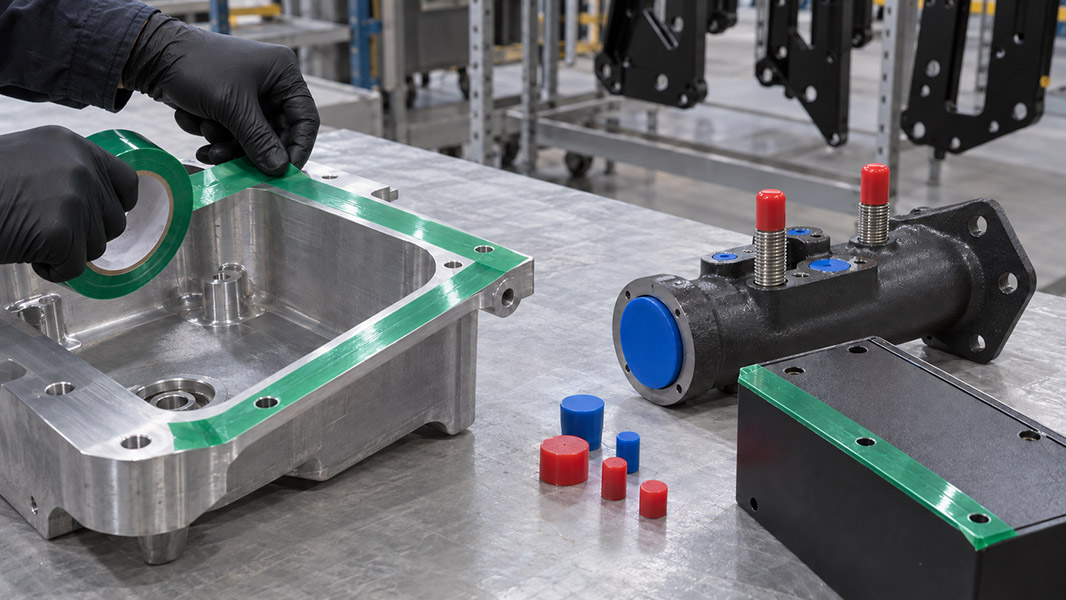
Translucent green PET tape on flat masking areas beside silicone caps and plugs
|
Feature |
Better starting method |
Is it a tape job? |
|
Internal thread or bore |
Silicone plug |
Usually no |
|
External stud or tube end |
Silicone cap |
Usually no |
|
Flat mating or sealing face |
Tape |
Yes |
|
Grounding contact or machined datum |
Tape |
Yes |
|
Paint break or two-color boundary |
Tape |
Yes |
|
Large-area closure |
Tape plus approved paper or foil |
Tape seals the perimeter |
Tape defines planes and boundaries. Plugs and caps suit holes, threads, studs, and ports.
|
Selection field |
J-350 |
J-630 |
|
Construction |
Green PET + silicone PSA |
Polyimide + silicone PSA |
|
Position |
Default flat masking tape |
Upgrade when PET is insufficient |
|
Temperature |
200°C working reference |
Contact for TDS |
|
Thickness |
0.05 / 0.06 / 0.08 mm |
Contact for TDS |
|
Adhesion to steel |
6.8 / 8.8 / 9.8 N/25mm, same order |
Contact for TDS |
|
Tensile strength |
≥60 / ≥80 / ≥100 MPa, same order |
Contact for TDS |
|
Elongation at break |
≥60% / ≥80% / ≥100%, same order |
Contact for TDS |
|
Standard length |
33 m / 66 m |
Contact for TDS |
Start with J-350 green PET silicone tape when the cycle fits the 200°C reference. Evaluate J-630 silicone polyimide tape for a higher setpoint, longer dwell, heavy part, or repeated bake. Confirm the current TDS and test production conditions.
Thickness affects handling and removal; it is not a temperature ladder. J-430 glass cloth tape is a 180°C electrical-insulation grade, not this mask. PTFE tape is for release and heat sealing.
Oven air temperature is not peak metal temperature (PMT). Heavy parts heat more slowly, extending tape exposure. PET may distort before the silicone adhesive fails. Compare dwell, substrate, test method, and failure criteria—not only the label. The Powder Coating Institute defines part bring-up time as the time needed to reach the desired metal temperature.
Read this for PMT or staged curing: Technical Guides.
200°C equals 392°F and sits in the “400°F green PET” band; it does not make J-350 a 204°C product. Key conversions: 0.05 mm ≈ 2 mil, 0.06 mm ≈ 2.4 mil, 0.08 mm ≈ 3 mil; 1/4 in = 6 mm, 1/2 in = 12 mm; 33 m = 36 yd, 66 m = 72 yd. These are purchasing equivalents, not inspection tolerances. Compare temperature test conditions.
For width selection, read How to Choose PET Silicone Tape.
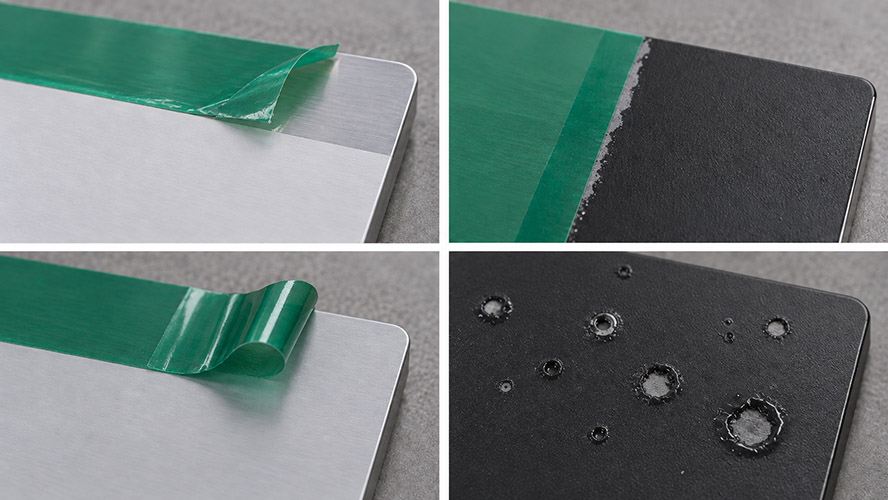
Powder coating masking defects: edge lift, bleed, PET curl, and fisheyes
|
Symptom |
Check first |
Upgrade tape only when… |
|
Edge lift |
Cleaning, dryness, pressure, tension, radius, PMT |
Clean, pressed tape still opens from backing distortion |
|
Powder bleed |
Edge contact, wrinkles, seam direction, spray angle, film build |
The backing cannot hold a correct seal through heat |
|
Adhesive residue |
PMT, dwell, substrate, tape lot, removal timing |
Residue follows the tape in a controlled thermal trial |
|
Shrinkage or curl |
Temperature profile, cycles, application tension |
PET distortion is confirmed and the cycle cannot change |
|
Fisheyes or craters |
Oil, silicone, dirty air, outgassing, pretreatment |
Taped and untaped controls make the defect follow tape contact |
|
Chipping on removal |
Coating bridge, film build, peel timing, coating adhesion |
Adhesion and removal controls pass first |
Many “tape failures” begin upstream. IFS Coatings links outgassing to porosity or oxidation and lists oil, silicone, water, or application contamination as crater causes. PPG also lists poor cleaning, silicone, dirty air lines, dust, and handling. Check the process before buying a hotter tape.
Read this for residue, lift, or bleed: Failure Analysis.
Silicone adhesive transfer may affect later bonding, sealing, repainting, or recoating and can contribute to fisheyes or craters. It is only one possible source; oil, moisture, dirty air, handling, and outgassing can create similar defects. Test representative taped and untaped parts through the complete thermal and downstream process before approval.
Approve the tape in three steps: representative sample, small production lot, then documented production release. Do not approve from a room-temperature hand test.
Send these eight items with the RFQ:
· required width;
· J-350 thickness, or request J-630 TDS;
· oven setpoint and actual or expected PMT;
· total residence time;
· number of heat cycles;
· substrate and part mass or wall thickness;
· marked photo of the protected area;
· current failure or masking problem.
Start with J-350 where the 200°C PET system fits. Move to J-630 only when evidence supports it. Request a sample or specification review.
They are in the same commercial band: 200°C is 392°F, while 400°F is about 204°C. Do not treat the labels as interchangeable without comparing dwell and test conditions.
When a controlled trial confirms PET distortion, or the real job has a higher setpoint, longer dwell, heavy-part heat-up, or repeated bake. Confirm the current J-630 TDS first.
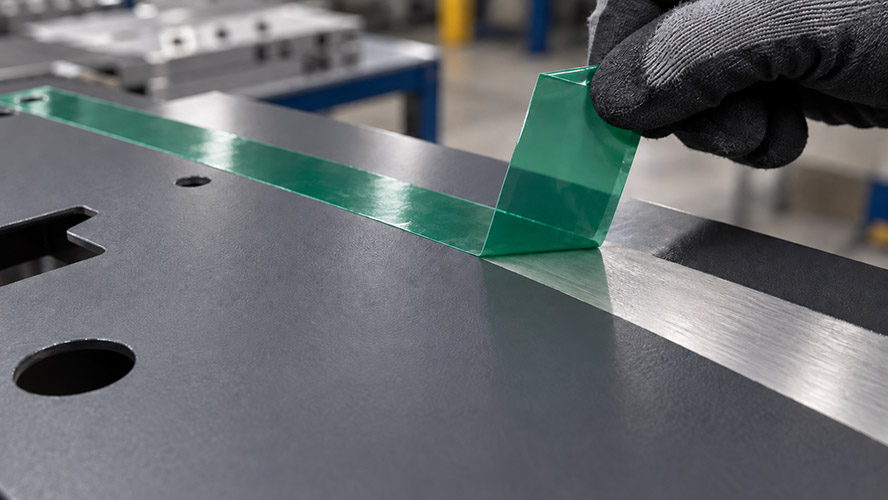
Trial warm and cooled removal on the actual coating. Document the condition that avoids residue, bridging, chipping, and unsafe handling.
Start with a correctly sized silicone plug for internal threads. Use tape on the surrounding flat face or boundary.
No. Silicone is one possible cause, but oil, cleaner residue, dirty air, outgassing, and pretreatment problems can look similar. Compare taped and untaped controls.