info@jxgreentape.com
A two-tone powder coating job can go wrong at the very end. One forum user described curing the second color, removing the masking tape, and finding residue that would not scrape off cleanly. The next option was sanding and recoating. That was not a material “detail.” It was rework.
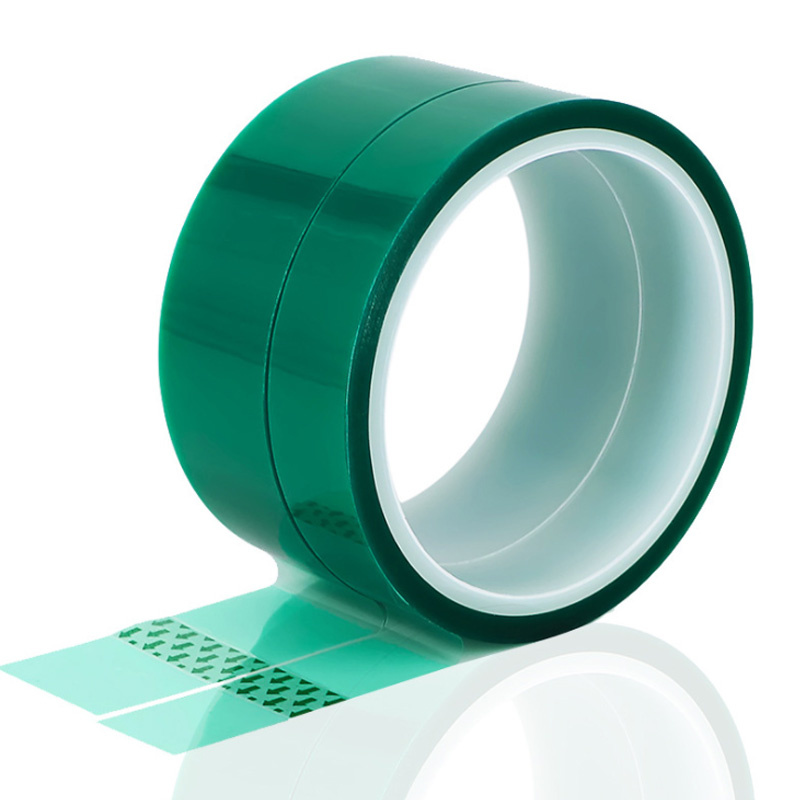
That is the point of choosing PET silicone tape carefully. Buyers are not only buying a green high temperature tape. They are trying to protect shipment time, labor cost, and coating quality after the oven door opens.
For powder coating, the tape has to do four things well enough: stay down, keep the coating edge clean, survive the bake cycle, and remove without turning into another cleaning job.
Green tape is popular because it is easy to see on aluminum and steel parts. That helps operators check the masking area quickly. But color is not a specification.
A PET silicone tape usually uses polyester film backing with silicone pressure-sensitive adhesive. Buyers may also call it PET silicone adhesive tape, polyester silicone adhesive tape, silicone coated polyester tape, or green polyester masking tape. Those names are useful for sourcing, but they do not tell you whether the tape will work on your part.
A smooth aluminum profile, a rough casting, a threaded hole, and a grounding point behave differently. The same tape can pass on one surface and fail on another. Surface texture, cleaning, pre-treatment, masking width, bake time, and removal timing all matter.
For B2B selection, start with the basic data. These are typical J-350 values and should be confirmed with the latest TDS before approval.
|
Item |
J-350-50 |
J-350-60 |
J-350-80 |
|
Backing Material |
PET film |
PET film |
PET film |
|
Adhesive |
Silicone |
Silicone |
Silicone |
|
Total Thickness |
0.05 mm |
0.06 mm |
0.08 mm |
|
Adhesion to Steel |
6.8 N/25mm |
8.8 N/25mm |
9.8 N/25mm |
|
Tensile Strength |
≥60 MPa |
≥80 MPa |
≥100 MPa |
|
Elongation at Break |
≥60% |
≥80% |
≥100% |
|
Temperature Reference |
200°C |
200°C |
200°C |
|
Standard Length |
33 m / 66 m |
33 m / 66 m |
33 m / 66 m |
For comparison, peel adhesion and tensile data should be read with the test method in mind. ASTM D3330 is used for peel adhesion of pressure-sensitive tapes, while ASTM D3759 covers tensile strength and elongation.
For product samples, see J-350 PET silicone adhesive tape.
For many powder coating jobs, 0.06 mm is the easiest first sample to justify. It has enough body for handling, but it is not usually too stiff for normal edges.
The 0.05 mm grade still has its place. It can sit better on narrow lines, small contact areas, and tight details. Thin does not automatically mean weak. On a small edge, too much stiffness can be the bigger problem.
The 0.08 mm grade gives a stronger hand feel. It can be easier to peel from larger areas and may suit rougher surfaces better. But it can also fight tight corners.
A manufacturing buyer working mostly with 6061 aluminum described the trade-off clearly: their green polyester tape removed cleanly after baking, but sometimes lifted during handling and let paint get underneath, forcing operators to clean overspray. The issue was not residue. It was edge hold during the real process.
That is why thickness should be tested on the worst area, not the neatest sample panel.
Width looks like a purchasing choice. On the line, it becomes an operator problem.
A narrow roll works well for threaded holes, small tabs, grounding points, and fine masking lines. It wastes less material and is easier to place. But if the operator stretches it during application, it may pull back during baking.
A wider roll covers faster on long aluminum profiles, appliance housings, steel panels, and larger protected zones. On curves, folded edges, or rough surfaces, it can wrinkle or trap air.
Custom slitting is useful because the right width makes the work repeatable. It reduces waste, improves edge control, and cuts down on improvisation at the bench.
For J-350, 200°C should be treated as the main temperature reference. If your line often runs near 220–230°C, test the tape on the real part before bulk approval.
Temperature alone is not enough. A short bake is different from a long dwell. A thin steel bracket and a thick aluminum casting may not experience heat the same way, even in the same oven.
The silicone adhesive is not the only limit. PET film can shrink, curl, or lose dimensional stability if it is pushed too far. Once that happens, the edge may pull, the line may become rough, and removal may become harder.
So the better question is not simply “Can it handle 220°C?” Ask: how long is the part hot, how thick is the part, and what happens when the tape is removed?
Residue is easy to blame on the tape. Sometimes that is correct. Often, the process is giving you a clue.
Overbake, long dwell time, rough metal, oil, moisture, degreasing residue, phosphate or silane residue, powder build-up at the tape edge, and peel angle can all change the result.
Removal timing deserves more attention. In one powder coating masking discussion, operators warned that pulling tape before the part cools enough can leave melted adhesive residue and pull powder into stringy lines; waiting too long can also make removal more difficult.
There is no universal hot-pull or cold-pull rule. Test both timings on the actual part and record which one gives cleaner removal, less stringing, and a sharper line.
If the tape lifts on curves, do not immediately ask for stronger adhesive. Look at radius, tape width, film stiffness, surface dryness, and hand tension first.
If paint bleeds under the tape, check the surface texture and edge pressure. On rough castings or blasted aluminum, a thin tape may not bridge the surface well. On a tight corner, a thicker tape may not sit down.
Stronger adhesive can help in some cases, but it can also increase removal force and residue risk. When failures repeat, start with powder coating masking tape failure analysis before changing tape grades blindly.
PET silicone tape is a practical choice for many powder coating masking jobs around 200°C. Typical applications include aluminum profiles, steel chassis, appliance metal parts, automotive metal components, threaded areas, grounding points, machined surfaces, and mating surfaces.
It is not the first choice for every high-temperature process. Electronics soldering, special electrical insulation, permanent masking, repeated long high-heat exposure, and very low shrinkage requirements should be evaluated separately.
If you are comparing PET silicone tape with other high-temperature masking materials, use your material comparison guides to judge temperature window, film stability, removal behavior, thickness, and cost together.
One more point matters. Silicone adhesive is useful for heat masking, but downstream bonding, sealing, repainting, or another coating step needs surface compatibility testing. Powder coating defect guides list oil, moisture, surface contamination, and silicone among common causes of fisheyes or craters.
A clean flat panel is a start, not a final approval.
Use the actual part if possible. Include the roughest surface, the tightest bend, the widest protected area, and the most visible edge. Run the normal cleaning or pre-treatment step. Use the real oven profile and dwell time. Remove the tape the same way operators will remove it in production.
Record the basics: thickness, slit width, part material, surface condition, bake temperature, dwell time, removal timing, residue, edge lift, paint bleed, tape breakage, and whether the part will be bonded or coated again.
When requesting samples, send the part material, masking width, bake temperature, dwell time, removal timing, and current failure problem. That gives the first sample a better chance of being useful.
Q1: Why did the tape pass on a flat panel but fail on real parts?
Flat panels are too easy. Real parts have edges, holes, corners, surface texture, weld marks, oil pockets, and uneven heating. Test the hardest masking area first.
Q2: Is 0.08 mm always better than 0.05 mm?
No. A thicker tape may peel more steadily from large areas, but it may not sit well on tight corners. A thinner tape may work better on small edges and narrow masking lines.
Q3: Should PET silicone tape be removed hot or cold?
Test both. Warm removal may reduce peel force, but it can also cause stringing or edge damage in some processes. Cold removal may give better control, but it may require more force.
Q4: Can PET silicone tape be used at 220–230°C?
Possibly for short, controlled exposure, depending on dwell time, part temperature, and oven profile. Do not treat 220–230°C as a universal rating. If this range is common, test real parts carefully.
Q5: Why does clean-removal tape still leave residue?
Because clean removal depends on the process. Overbake, chemical residue, moisture, rough metal, powder build-up, wrong peel angle, or poor timing can all change the result.
Q6: What should we send before asking for samples?
Send the part material, required masking width, thickness preference, bake temperature, dwell time, surface condition, removal timing, and current masking problem. A good sample request prevents testing the wrong roll twice.
Need help choosing PET silicone tape for powder coating masking?
Send us your part material, masking width, thickness preference, bake temperature, dwell time, surface condition, removal timing, and current masking issue. We can recommend a suitable J-350 thickness and provide samples for real-part testing.