
info@jxgreentape.com
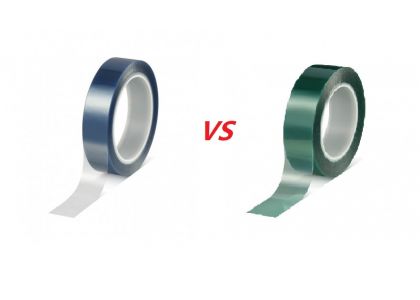
A cheaper blue tape lands on your desk. It looks close to the green PET tape already running on the coating line, and the supplier calls it a high-temperature equivalent. The saving is attractive. So is qualifying a second source.
Still, something does not quite add up. “Blue” tells you what the roll looks like, not what is inside it. The backing may be PET, paper, or something else. Even two PET/silicone tapes can differ enough to create edge lift, slivering, or slower removal.
That is the real question behind a green-versus-blue powder coating tape search: not which color is better, but whether two apparently similar tapes are genuinely interchangeable. The answer rarely comes from the color—and not always from the TDS alone.
Color has a useful job in the factory. It helps operators spot missed areas, follow masking boundaries, and confirm that no strip remains after curing. A plant may also use color to separate lines or removal stages.
The trouble starts when a local work instruction becomes a purchasing rule. There is no universal convention that green means one temperature class or blue means a particular backing. A useful in-plant color code may be meaningless outside it.
Calling for “blue high-temperature tape” is therefore understandable, but incomplete. It gives the supplier a visual reference while leaving the technical definition open to interpretation.
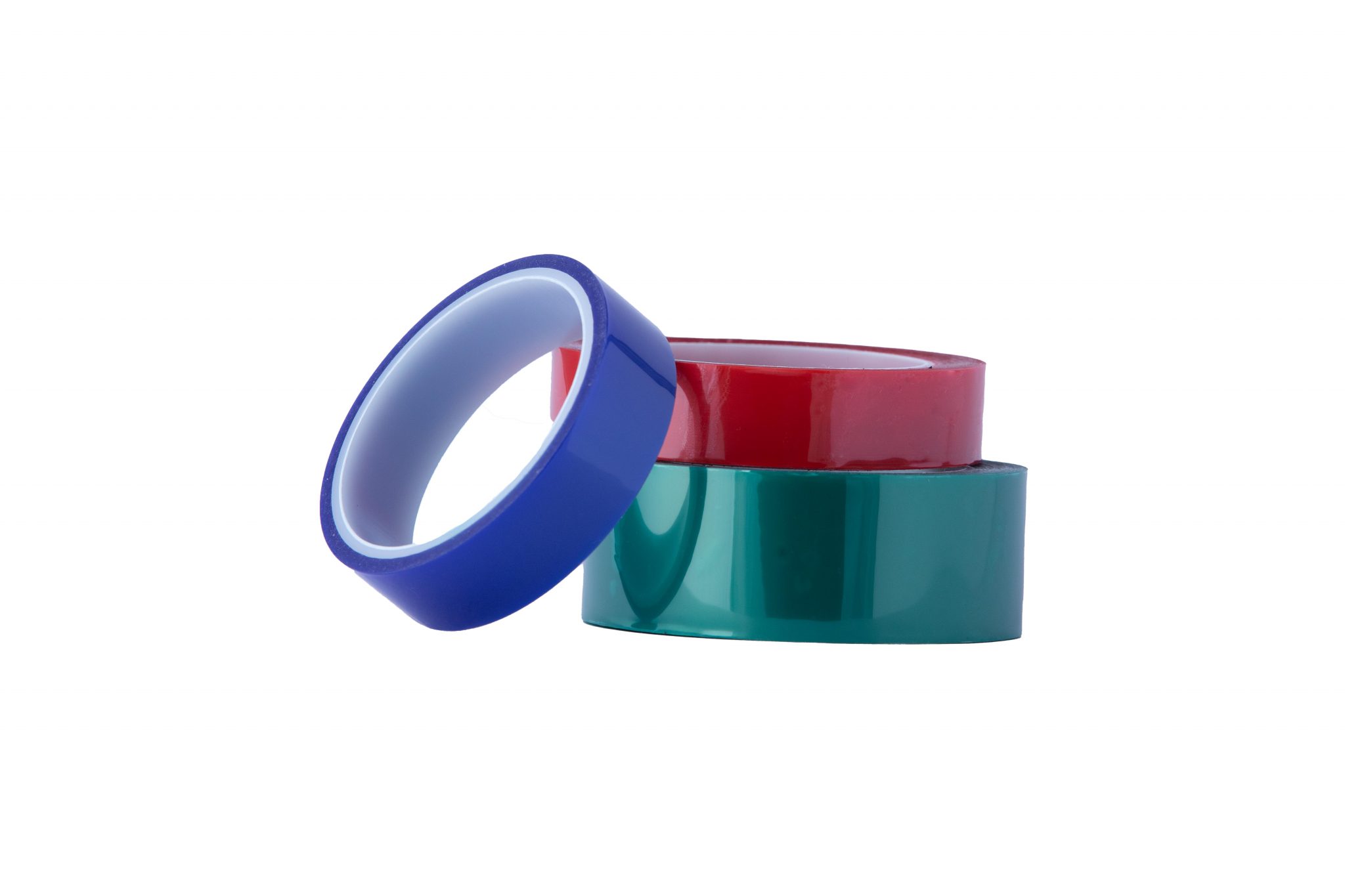
Public product data makes this point neatly. 3M Polyester Tape 8991 uses a translucent blue PET backing with silicone adhesive; the related 3M 8992 is green and thicker. Tesa also sells green and blue polyester/silicone masking grades.
These examples do not prove equivalence. Even within the PET-and-silicone family, color can accompany changes in thickness, conformability, or other grade-specific properties.
“Green PET silicone tape” identifies the backing, adhesive family, and color. It does not confirm total thickness, temperature with dwell time, adhesion, tensile properties, removal temperature, or roll-to-roll tolerance.
Those details may be understood for a familiar grade. With a replacement, write them down. Match green PET silicone adhesive tape to the substrate, oven profile, geometry, and removal method—not the approved roll’s color.
Whether the trigger is cost, supply risk, or second-source qualification, start by confirming the backing. A blue PET/silicone tape may be a plausible alternative. A blue paper tape belongs to another construction; a shared “high-temperature” label does not make it equivalent.
Then check the adhesive system, but resist the easy shortcut of treating one chemistry as clean and another as troublesome. Formulation matters. So do the surface, heat history, application pressure, contamination, and removal condition.
Film thickness and total thickness deserve separate entries. Heavier PET may pull off more readily in one piece, yet its stiffness can lift on a tight curve. Thinner film may conform better but stretch or split during removal. There is no winning thickness in isolation.
Temperature is the last desk check, and perhaps the one most often oversimplified. Ask how long the tape was exposed, on what substrate, and whether the published figure represents a peak or a defined working condition. If the supplier cannot explain the number, it is not yet an approval criterion.
The first screen is straightforward. Compare supplier-declared data before spending production time on a trial. Use the table below as a sample-approval worksheet, not as a supplier specification sheet.
|
TDS item |
Current green tape |
Proposed blue tape |
Evidence needed |
|
Backing material |
Confirmed construction |
Supplier declaration |
TDS or material declaration |
|
Film thickness |
Current value |
Proposed value |
Value and tolerance |
|
Total thickness |
Current value |
Proposed value |
Test method and tolerance |
|
Adhesive system |
Confirmed chemistry |
Supplier declaration |
TDS |
|
Temperature exposure |
Temperature and time |
Temperature and time |
Comparable conditions |
|
Adhesion |
Current value |
Proposed value |
Method and test substrate |
|
Tensile and elongation |
Current values |
Proposed values |
Test method |
This table cannot predict residue. It can rule out poorly matched or documented candidates. Where the construction differs, a high-temperature masking tape material comparison can show whether a factory trial is worth arranging.
Notice what is deliberately absent from the table: clean removal, adhesive transfer, slivering, and coating-edge quality. Those are production results, not specifications a new supplier can establish on your behalf before the trial.
Oven set temperature and part-metal temperature are not the same. Different components heat at different rates, while the tape experiences the ramp, peak, dwell, and unloading delay. A single maximum-temperature number misses most of that story.
Apply both tapes to production substrates after normal pretreatment. Include a flat section, an edge, and the tightest representative curve. Control application pressure, then run the actual oven profile.
After curing, look for shrinkage, curling, edge lift, and powder penetration. Remove each tape at its specified temperature.
Record adhesive transfer and slivering separately. Adhesive transfer primarily points to the adhesive–surface interaction and heat history. Slivering describes a backing failure during removal, often influenced by film strength, adhesion level, bake exposure, and peeling technique. Also check for ghost marks, coating-edge damage, and powder flaking from the tape backing.
|
Production result |
Current tape |
Proposed tape |
|
Edge lift or shrinkage |
Baseline |
Pending trial |
|
Powder penetration |
Baseline |
Pending trial |
|
Adhesive transfer |
Baseline |
Pending trial |
|
Ghost marks or staining |
Baseline |
Pending trial |
|
Slivering or film breakage |
Baseline |
Pending trial |
|
Powder flaking from tape backing |
Baseline |
Pending trial |
|
Removal temperature and effort |
Current process |
Pending trial |
One successful component is encouraging, not conclusive. Test several parts, including the hardest geometry and longest credible dwell. If parts may be recoated, include that condition. The steps in how to choose powder coating masking tape can turn the results into a repeatable approval record.
A cheaper roll does not need to cause a spectacular failure to become expensive. An extra ten seconds spent picking broken strips from every part can be enough. Adhesive transfer adds cleaning; edge lift creates touch-up work; powder flakes from the tape can contaminate an otherwise acceptable finish.
None belongs to a color. The likely causes include adhesive balance, backing strength, surface preparation, geometry, heat exposure, and application technique. For an existing symptom, begin with powder coating tape failure analysis instead of simply requesting a thicker or hotter grade.
Uncertainty is another cost. A poorly documented product may be usable, but the buyer pays for missing information through extra trials and tighter incoming inspection.
This does not mean a lower-priced replacement should be rejected. Far from it. A well-documented alternative that survives a representative trial may be exactly what the business needs. The point is simply that unit price becomes meaningful only after the removal time, rework risk, and process stability are understood.
PET/silicone tape is a sensible starting point for many powder coating masks, but not a universal answer.
Polyimide may be worth testing near a proven PET limit or where a very thin mask is needed; it is not automatically cleaner. Glass cloth suits selected jobs requiring greater mechanical or abrasion resistance, but ordinary electrical-grade glass cloth should not be sold as blasting tape without product-specific evidence. High-temperature crepe paper may suit certain curves or lower-heat steps, depending on the grade.
These are useful boundary cases, not reasons to turn a PET comparison into a catalogue of every masking material available.
Caps and plugs are a different masking format, not alternative backings. For repeated holes, threads, and studs, molded parts may be faster to handle. Comparisons of high-temperature masking options can eliminate candidates that do not fit the geometry.
Keep color in the work instruction if it helps operators. In the purchase specification, write the backing, adhesive system, film and total thickness, tolerances, bake temperature with time, approved substrate, removal condition, roll dimensions, and any die-cutting requirement.
For sample matching, send the current TDS, part material, pretreatment, oven profile, geometry, removal temperature, and the failure to avoid. A photograph is useful; it just should not be the most technical document in the RFQ.
A useful request sounds like this:
PET-backed masking tape with silicone adhesive, matching the attached thickness range and validated for the stated oven profile. The tape must maintain the masking edge and remove under the specified conditions without adhesive transfer or backing breakage.
Color can remain in that description as an operational preference. It should not be carrying the engineering requirement by itself.
A supplier says its blue tape is equivalent to our green tape. What should we request before accepting samples?
Request the TDS, backing and total thickness, adhesive system, tolerances, temperature with dwell time, test substrate, and recommended removal condition. If these align, proceed to a side-by-side trial. Similar color, feel, and room-temperature tack do not prove production equivalence.
Both tapes use PET film and silicone adhesive. Why might one still fail?
PET and silicone describe only the broad construction. Film thickness, adhesive coat weight, formulation, backing treatment, and manufacturing tolerances can change conformability, heat shrinkage, edge holding, and removal. The difference may not appear until the tape has aged under heat on the actual surface.
Is one successful bake enough to approve a second supplier?
Usually not. One part does not represent different component heat loads, the longest oven dwell, difficult curves, or batch variation. Test several parts under the worst credible production condition. Where repeat curing or recoating is possible, include it in the approval rather than treating it as an exception later.
How can we compare temperature ratings when suppliers use different conditions?
Ask for peak temperature, exposure time, number of cycles, test substrate, and removal condition. If these differ, the headline values are not directly comparable. Run both products against the same part-metal temperature and dwell time; the larger published number is not automatically the safer choice.
Does a thicker PET film reduce residue or slivering?
Not in the same way. Thickness mainly affects mechanical removal. A heavier film may resist tearing and come off in one piece, but it does not by itself prevent adhesive transfer. Residue depends more directly on adhesive formulation, substrate, heat history, application pressure, contamination, and removal condition.
Evaluating a green or blue PET masking tape for your coating line? Send us the current tape specification, part material, oven profile, masking geometry, and removal conditions. We can help identify a comparable construction and prepare samples for a controlled production trial.