
info@jxgreentape.com
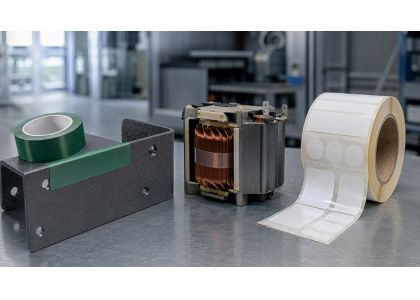
Put three rolls on a workbench—a green masking tape, a polyester electrical tape, and an unprinted label laminate—and few engineers would confuse one for another. Reduce them to a spreadsheet, however, and each may be described as PET film with a pressure-sensitive adhesive. That shorthand is convenient. It is also where many sourcing mistakes begin.
The practical difference is not PET itself. One product has to survive a coating cycle and peel away, another has to remain inside a coil, while the third must accept ink, die-cut cleanly, dispense at line speed, and stay on its final substrate. Buyers comparing PET tape and PET label film therefore need to specify the next process and the unacceptable failure, not just the film and adhesive family.
PET can provide a smooth surface, useful tensile strength, and dimensional stability. Those properties do not tell us how the roll should be coated and converted or what failure must be prevented.
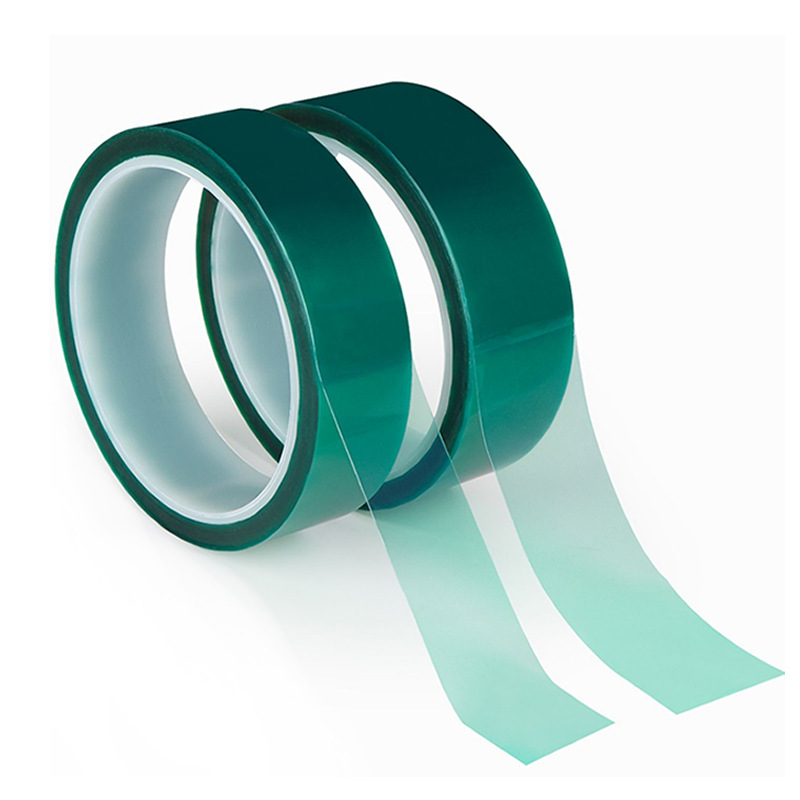
A uses polyester film as the backing and a silicone pressure-sensitive adhesive. It is commonly evaluated for powder coating, high-temperature paint masking, and temporary metal-finishing protection. The job is temporary: hold the edge through the stated oven cycle, then come away without creating unnecessary cleanup. Relevant buying details include total thickness, adhesion, peak temperature, dwell time, removal condition, width, and roll length.
A PET electrical insulation tape takes a different route. Polyester film is combined with acrylic pressure-sensitive adhesive for insulation and mechanical protection in motors, transformers, coils, and electronic assemblies. This tape may remain in the product. Buyers therefore need to consider thickness, dielectric strength, tensile strength, adhesion, thermal aging, winding behaviour, and compatibility with the complete insulation system.
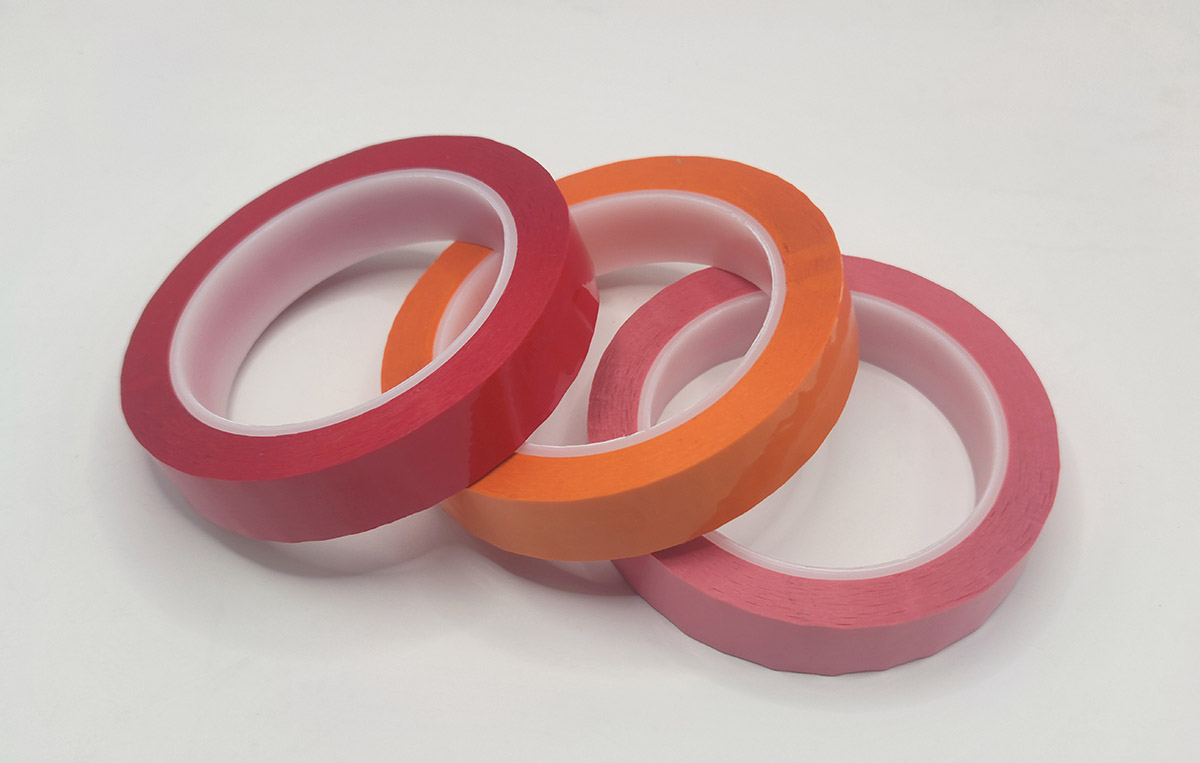
Calling both products “PET film with adhesive” is technically true and commercially unhelpful.
Industrial tape normally arrives ready for application. Masking tape is removed at the planned stage; insulation tape remains in the assembly; bonding tape carries a defined load on actual surfaces. Most conversion work is already complete.
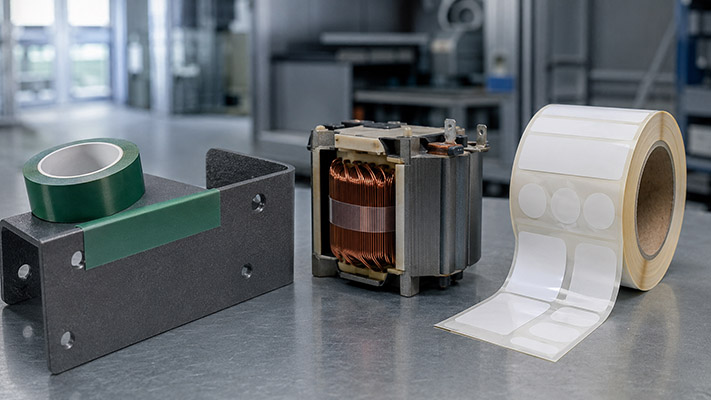
Self-adhesive label film still faces printing, die-cutting, matrix stripping, rewinding, and possibly high-speed dispensing. Only then does the adhesive meet the bottle, equipment housing, cable, or shipping container.
PET is often chosen for durable identification where dimensional stability and resistance to handling matter. BOPP label film is common in beverage, food, personal-care, and general packaging applications where conformability, appearance, and converting economics may carry more weight. Neither description is a guarantee: the topcoat, ink, adhesive, liner, container, and service conditions still decide the result.
Buyers comparing printable facestocks can find a practical overview of PET, BOPP, adhesive, and liner options in Self Adhesive Film for Labels | PET & BOPP | Guanma.
When tape lifts or a label falls off, the film is easy to blame because it is the visible layer. Quite often, the more useful investigation starts at the surface.
Oil, pretreatment residue, dust, rough powder coating, or mold-release agent can prevent wet-out. Polypropylene also presents a more difficult surface than clean stainless steel. Before increasing coat weight, compare cleaned parts with untreated production parts; the result may expose contamination as the real cause.
Label stock adds the printable face. A dyne reading can screen wetting, but it does not prove that ink will remain bonded after printing, curing, rubbing, and aging. Confirm which side was tested, whether it is corona-treated or top-coated, and the intended print process. An actual print and rub trial is worth more than an isolated dyne number.
There is also the bond between the adhesive and the PET itself. Poor adhesive anchorage can appear as residue after masking, transfer to the application surface, or edge ooze during label conversion. That is why “peel adhesion to steel” cannot diagnose every adhesive problem.
Peel adhesion is easy to misuse. A comparison needs the test method, angle, speed, panel, dwell time, and conditioning. ASTM D3330 cautions that backing stiffness and adhesive rheology affect the response and that peel results do not necessarily translate into a functional requirement.
A material may pass peel testing on stainless steel but lift from molded PP. The steel result supports quality control; it does not reproduce low surface energy, curvature, texture, release-agent residue, or limited application pressure.
Temperature figures need similar restraint. “200°C resistant” might describe brief oven exposure, not continuous service. For masking tape, the buyer should provide peak temperature, dwell time, part material, cooling stage, and expected removal condition. For permanent electrical tape, long-term thermal aging and insulation-system compatibility matter more than surviving one short heating cycle.
Thickness creates another quiet source of quotation errors. A request for “50-micron PET adhesive film” may mean 50-micron PET alone, 50-micron total tape thickness, or a 50-micron label facestock before adhesive and liner are added. Those are not interchangeable specifications.
Before approving a quotation, ask the supplier to restate what each thickness and performance figure includes and how it was measured. That short clarification is cheaper than discovering after delivery that the two sides were discussing different constructions.
Sometimes a finished label bonds perfectly, yet the converter still rejects the material. The trouble appears earlier.
If the release liner and adhesive are poorly balanced, the die may cut into the liner, small labels may lift with the waste matrix, or the label may refuse to separate cleanly at the dispensing plate. A soft or heavy adhesive coat can improve initial wet-out while also encouraging edge ooze, die contamination, blocking, or matrix breaks. Higher tack is not automatically better converting.
The liner is not disposable packaging. Its thickness, release behaviour, dimensional stability, and die-cutting compatibility belong in the label specification. Buyers running small shapes or high-speed dispensing should approve the converted roll, not only a hand-applied sample.
A useful RFQ does not need to become a technical essay. It needs to describe the process clearly enough that the supplier is not forced to guess.
For an industrial masking job, a buyer might write:
We need a green PET silicone tape for masking aluminum parts during powder coating. The oven cycle is 190°C for 20 minutes. The tape will be removed after partial cooling, and low residue is important. Required size is 25 mm × 66 m. Please provide samples for testing on our pretreated aluminum surface.
For label stock, the same buyer might write:
We need a white PET label stock for thermal-transfer printing and application to powder-coated steel equipment. Finished label size is 40 × 20 mm, with automatic dispensing. Service temperature is −20°C to 80°C. Please recommend the facestock finish, adhesive, liner, roll direction, and compatible ribbon type for sample validation.
These requests simply tell the supplier where the risk is.
The material overlap between tapes and label stock is real, but supplier experience should match the finished product. Industrial tape projects call for knowledge of masking, insulation, bonding, or reinforcement. Printable label stock adds print treatment, die-cutting, liner release, and dispensing. A broader view of these label-material options is available through Self Adhesive Film for Labels | PET & BOPP | Guanma.
If one RFQ can be sent unchanged to both an industrial tape manufacturer and a label-stock supplier, it is probably not specific enough. PET identifies the polymer. It does not explain the job, the critical surface, or the failure that must be prevented.
For an industrial PET tape project, send the supplier the substrate, process temperature, exposure time, permanent or removable requirement, roll size, and estimated quantity. Add a photo if the surface is curved, textured, coated, or difficult to describe. With that information, a supplier can decide whether an existing grade is worth sampling or whether the construction needs further discussion. Final approval should still use actual parts and production conditions.
Why did a PET masking tape remove cleanly in one trial but leave residue after a longer oven cycle?
Peak temperature is only part of the exposure. Longer dwell can soften or age the adhesive, increase its bond to the part, or weaken adhesive-to-film anchorage. Removal temperature and angle also change the result. Compare the complete oven profile and removal conditions before changing thickness or asking for a stronger adhesive.
Why did a label pass peel testing on stainless steel but lift from molded PP?
Stainless steel is a clean, relatively high-energy reference surface. Molded PP may have lower surface energy, texture, curvature, or mold-release residue. Test cleaned and as-molded parts separately. That simple comparison often shows whether the next step should be better surface preparation or a different adhesive.
Is a 38-dyne PET film automatically ready for UV printing?
No. Dyne level helps assess wetting under the test conditions; it does not confirm ink compatibility, sufficient UV curing, topcoat adhesion, or resistance to rubbing and aging. Approve the film with the intended ink, press settings, curing conditions, and a defined adhesion test.
Can a stronger adhesive make label converting more difficult?
Yes. A softer or heavier adhesive layer may improve initial tack but can also contribute to edge ooze, die contamination, matrix breaks, blocking, or unstable liner release. Final bond strength and converting behaviour should be tested together rather than optimized separately.
Related Articles: