
info@jxgreentape.com
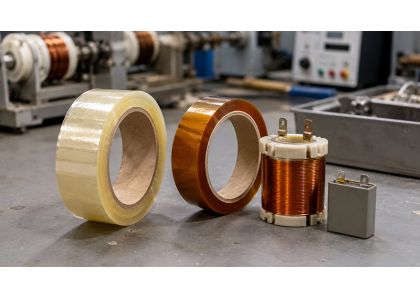
Engineers searching PET vs polyimide electrical tape usually want one practical answer: when is polyester sufficient, and when is polyimide worth the added cost? For permanent electrical insulation tape, the answer depends on thermal exposure, available build, dielectric evidence and the finished assembly—not on which film sounds more advanced.
This comparison is for tape that stays in a coil, capacitor or compact component. Temporary masking is a different selection problem, although any hotter manufacturing cycle must still be included in qualification.
|
Start with |
When it is the more plausible candidate |
Main reason to reject it |
|
PET electrical insulation tape |
Moderate heat; coil cover, layer support or capacitor wrapping; sufficient build space |
Thermal limit or completed-part thickness leaves too little margin |
|
Acrylic polyimide tape |
Thin polyimide is needed, non-silicone contact is preferred, or the listed 155°C direction fits |
More heat capability is required or adjacent materials are incompatible |
|
Silicone polyimide tape |
Higher heat exposure and a thin construction matter together |
Silicone is unacceptable or long-term life is being inferred from one temperature number |
Let PET try to qualify first when its limits fit. Move to polyimide when temperature, space or another documented requirement removes PET from consideration.
A “Mylar vs Kapton tape” search sounds like a contest between films. Finished behavior also depends on adhesive chemistry, backing and total thickness, coating uniformity, slit edges and roll build.
Before comparing quotations, align backing, adhesive, backing thickness, total thickness, temperature definition, electrical test method and tolerance. Otherwise, one supplier’s film value may be compared with another’s finished-tape value.
If the job also needs abrasion resistance, low stretch or holding force, polyester vs polyimide electrical tape may be the wrong comparison. The Electrical Insulation Tape Solutions guide explains where glass cloth and reinforced tapes fit.
Temperature labels deserve a pause. A process peak, a one-hour bake and continuous service are not equivalent. A catalog temperature also does not assign a thermal class to the complete device.
IEC 60085 distinguishes an insulating material from an electrical insulation system, while IEC 60216-1 describes ageing procedures for deriving thermal-endurance characteristics. A catalog number helps screening; it does not establish service life (IEC 60085:2007; IEC 60216-1:2025).
The products compared here list 130°C for PET/Mylar Electrical Tape, 155°C for Acrylic Polyimide Tape, and 260°C for Silicone Polyimide Tape. Their pages do not publish a common test method and duration, so the figures are not directly equivalent. The 260°C value, in particular, does not by itself define continuous service at 260°C.
Ask: how hot does the tape itself become, for how long, and which property may change after ageing? Then test the complete construction at normal and worst-case conditions.
Thin electrical insulation tape preserves winding-window fill and clearance, but becomes less forgiving of sharp edges, particles, wrinkles and inconsistent tension.
|
Construction |
Adhesive |
Total thickness |
Published electrical strength |
Published temperature resistance |
|
PET/Mylar electrical tape |
Acrylic |
0.055 or 0.08 mm |
≥5.0 or ≥5.5 kV |
130°C |
|
Acrylic polyimide tape |
Acrylic |
0.06 or 0.08 mm |
≥4.0 kV |
155°C |
|
Silicone polyimide tape |
Silicone |
0.06 or 0.08 mm |
≥4.5 or ≥6.0 kV |
260°C |
Data note: these supplier-published values do not include all test conditions on the linked pages, so the kV figures are not directly comparable. Confirm the TDS, method and tolerance. Relevant electrical-tape test references include ASTM D1000 and IEC 60454-2.
Polyimide does not automatically produce the highest finished-tape breakdown value. More importantly, breakdown voltage is not the equipment’s permitted working voltage. ASTM D149 and IEC 60243-1 use defined specimen conditions; designers must still consider ageing, creepage, clearance, defects and the insulation system (ASTM D149; IEC 60243-1).
Measure finished build at overlaps. A 0.06 mm tape creates more than 0.06 mm locally where layers cross—easy to miss when a drawing specifies tape thickness but not maximum part diameter.
PET is often the practical first coil insulation tape for outer cover, layer support and general component isolation under moderate heat. It is also a common capacitor insulation tape direction when the required build fits. Its value is economical film insulation, not being “almost as good” as polyimide.
A major-manufacturer polyester film electrical tape is likewise positioned for coils, capacitors and transformers at a stated 130°C rating (3M Polyester Film Electrical Tape 1350F-1). That supports the application direction, not the rating of every PET tape.
Apply PET at production tension and the real wrap count. Check width, wrinkles, overlap movement, edge lift and adhesive squeeze before and after the intended bake or ageing cycle with the actual varnish or impregnant. Peel on steel does not reproduce enamelled wire or insulation film.
PET becomes weaker near a sustained hot spot, under a very tight build limit, or when qualification exceeds the grade’s evidence. Adding wraps may then erase its space and cost advantage.
Polyimide electrical insulation tape earns its cost in compact coils, tight cavities and local barriers where heat and space constraints occur together. Acrylic polyimide suits non-silicone requirements when its 155°C product direction fits. Silicone polyimide is the higher-heat candidate, subject to adhesive compatibility and ageing validation.
3M makes the same adhesive distinction: its acrylic polyimide tape is listed for thin transformer, capacitor and harness insulation at 155°C, while a silicone grade is listed for coils, harnesses and capacitors at 180°C (3M Polyimide Tape 1205; 3M Polyimide Tape 92). These examples support the logic; their ratings and approvals do not transfer to another tape.
Inspect slit edges and wrap a narrow sample around the smallest radius. Check tearing, spring-back and corner lift after tension is released. Polyimide solves thermal and space problems; it cannot compensate for poor converting.
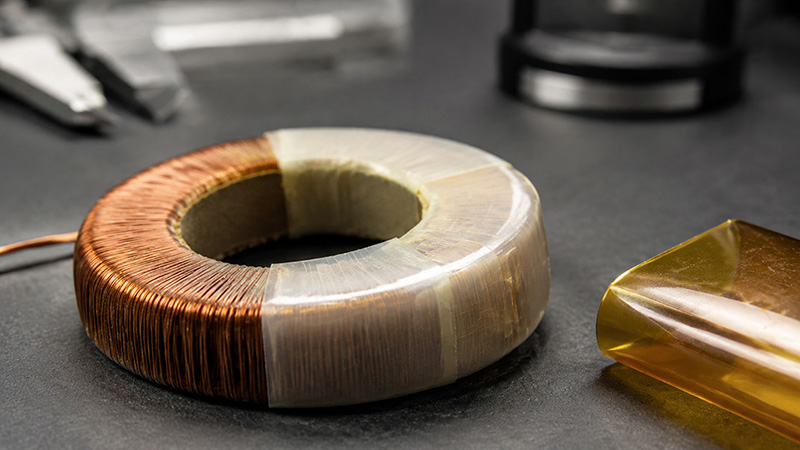
Acrylic versus silicone is not simply low heat versus high heat. Acrylic may suit non-silicone contact; silicone may offer more thermal headroom. Either can fail with the wrong substrate, pressure, ageing cycle or adjacent chemistry.
Test a small real assembly with the applicable enamelled wire, insulation film, varnish, resin, oil or potting compound. After ageing, check edges, adhesive movement, film condition and electrical performance. Do not specify “varnish compatible” or “oil resistant” without naming the material and exposure.
For a deeper adhesive comparison, see the polyimide tape selection guide.
PET usually starts cheaper, but slitting yield, application speed, scrap and rework determine cost per accepted part. A tape that wrinkles on an automatic winder may not remain cheaper.
The opposite mistake is specifying polyimide everywhere “for safety.” If PET passes the agreed checks with suitable margin, unused heat capability adds cost rather than reliability.
Changing an approved tape may require samples, drawing revisions, customer notification or requalification. Batch consistency, tolerances and change control belong beside unit price.
A useful RFQ includes:
● insulation position and function;
● normal, maximum and transient tape temperature, with duration;
● total-thickness and completed-part build limits;
● electrical requirement and test method;
● substrate, varnish, resin, oil or potting materials;
● adhesive restriction, winding tension, wrap count and smallest radius;
● roll dimensions, forecast volume, TDS, reports and change-control terms.
Record the lot, machine settings and pass/fail criteria before wrapping. ASTM D1000 covers test areas including thickness, unwind force, breakdown, flagging, accelerated ageing and oil resistance; select only those relevant to the application (ASTM D1000).
Send the insulation position, temperature profile, build limit, electrical requirement, contact materials and roll demand. Suitable PET and polyimide constructions can then be shortlisted for validation.
Possibly, but not as a purchasing-only substitution. Compare backing, total thickness, adhesive, temperature evidence and electrical method; then rebuild the part and repeat relevant ageing, dielectric and dimensional checks. A qualified insulation system may need system-level review (IEC 60085:2007).
Only what the stated method and exposure support. It is not automatically a continuous-life claim or the device’s thermal class. Ask for duration, method, failure criterion and confirmation that the value applies to finished tape.
Because the result belongs to the complete specimen. Film thickness, adhesive, conditioning, electrodes and method can change it. Compare required-thickness samples under one agreed method rather than ranking polymers from unlike catalog values.
Use production tension, width, overlap and wrap count. Measure finished diameter; apply the intended bake, ageing and varnish or resin; then recheck edges, wrinkles, adhesive movement and dimensions before electrical testing. Flat-panel peel does not reproduce a wound coil.
Acrylic is a reasonable candidate when non-silicone contact is required and its documented range fits. Evaluate silicone when more heat capability is needed. Confirm either on the actual substrate with downstream varnish, resin, coating or potting.
Only when the drawing, customer specification or approval record requires it. Otherwise, clarify whether the buyer means a brand or a polymer family. Qualify alternatives by construction, performance, documentation and change control—not visual similarity.