
info@jxgreentape.com

In motor production, “insulation tape” can mean several things. It may stop an end winding from moving, protect a lead near a metal edge or retain a phase separator. The same motor can contain all three, and each position places a different demand on the tape.
A request for “high-temperature motor winding insulation tape” says little about the work involved. Selecting an electrical insulation tape for motor windings becomes easier once the position and likely failure are known. The Electrical Insulation Solutions page covers the wider material range.
Use this table to choose samples. Winding type, voltage, geometry and varnish may change the final choice.
|
Winding position |
Typical purpose of the tape |
Construction worth evaluating first |
What usually causes trouble |
|
End turns |
Restrain conductors or protect contact points |
Glass-filament for holding; glass cloth for abrasion |
Tension, bends, edge lifting |
|
Lead wires |
Anchor or protect the lead |
Reinforced anchor; glass-cloth wrap |
Pull direction, sharp edges, post-bake movement |
|
Phase area |
Retain a separator; add local coverage |
Thin polyimide where space is restricted |
Mistaking tape for the complete barrier |
|
Coil banding |
Keep components positioned |
PET/glass-filament or PET/woven-glass |
Elongation, overlap, unwind |
|
Slot edge and crossover |
Hold a liner; cover a rubbing point |
Glass cloth or thin film |
Puncture, cutting, movement |
Tape works beside enamel, slot liners, phase barriers, sleeving and varnish. A high dielectric value does not give it the function of every surrounding material.
A catalogue temperature does not create a motor thermal class. A 155°C or 180°C tape may sit within a Class F or Class H design, but the system is evaluated as a whole (IEC 60085; IEC 60034-18-1; ANSI/UL 1446).
A 5 kV breakdown result describes a test specimen, not the motor’s working-voltage rating.
At the sourcing stage, a marked-up photo is often more useful than a longer list of material adjectives. It shows the curve, nearby contact points and intended overlap—the details that decide whether a film or cloth construction can sit properly.
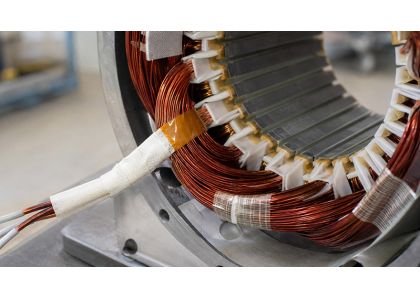
At an end turn, decide whether the tape must hold the winding or protect it. The two duties favour different constructions.
A moving end winding is sometimes “upgraded” to higher-temperature polyimide. The film survives, yet the winding still shifts because heat was not the problem. For restraint, a PET/glass-filament reinforced electrical tape is more relevant. The published grade is 0.17 mm thick, with 4.2% elongation and 1,300 N/25 mm tensile strength. It is a low-stretch candidate, not an automatic approval.
Where a lead or tie rubs against the wrap, woven glass cloth electrical tape provides a tougher contact layer and follows an irregular path. An end turn insulation tape RFQ should therefore say “holding” or “abrasion protection.”
Width changes the result. Narrow tape follows a small radius but creates more ends; wide tape needs fewer passes but may bridge and wrinkle. Trial two widths at equal tension rather than choosing by roll price.
Pay particular attention to the last turn of tape. A wrap may look sound through most of its circumference and still begin lifting at the termination after heat. Photographing that point before and after cure gives purchasing, production and the supplier something concrete to compare.
Motor lead wire tape may be an anchor, a protective wrap or both. Initial tack helps application, but elongation, edge tearing and retention after heat say more about long-term anchoring.
Mark the lead position and pull-test the assembly before and after baking. Sliding beneath an intact wrap points to the surface or adhesive. An edge split suggests tension, width or a sharp transition. A rotating wrap is probably anchored in the wrong place. That record helps more than “not sticky enough.”
Rewind shops should test aged enamel separately. A fresh laboratory coil does not settle adhesion on an old winding.
Polyimide tape for motor insulation is useful where space is genuinely tight. Acrylic polyimide tape and silicone polyimide tape are available in 0.06 and 0.08 mm constructions. Acrylic suits non-silicone requirements; silicone may suit a verified higher-heat process.
The phrase phase insulation tape can mislead. Tape often retains a shaped separator, closes a local gap or holds insulation during winding. Some compact motors use polyimide more extensively, but only as part of a validated design.
“Kapton tape” does not identify the adhesive, finished thickness or thermal condition. Where winding build matters, specify maximum total thickness and test the overlap. Two poorly placed thin layers may occupy more room than one correct layer.
This matters most in compact stators. A nominal 0.06 mm layer may appear acceptable on paper, while an overlap doubles the build at precisely the tightest point. Single-layer thickness alone can therefore mislead.
Glass cloth, PET/woven-glass laminate and PET/glass-filament tape are sometimes grouped together as “fiberglass tape.” Their behaviour under tension is quite different.
Woven glass cloth conforms and resists abrasion. PET film laminated to woven cloth adds a continuous film layer and two-direction reinforcement. The PET fiberglass cloth tape listed here is 0.14 mm thick, with 5% elongation and 1,000 N/25 mm tensile strength. PET/glass-filament tape is the more direct low-stretch option along its principal reinforcement.
Align sample width and test method before comparing tensile figures reported in N/10 mm and N/25 mm. Even then, a conformable construction may stay on an irregular coil better than a stiffer, higher-strength tape.
A motor coil banding tape also needs predictable unwind. Changing unwind force changes wrapping tension. Check roll build, slit edges and unwind during the pilot lot; ordinary converting details often decide whether the tape works. See Material Comparisons for broader comparisons.
Backing construction also changes how that tension reaches the coil. A high straight-line tensile result is of little comfort if the tape will not follow the corner, or if its edge begins splitting while the operator pulls it into position.
A secure-looking wrap may lift after varnish cure. Possible causes include contamination, an incompletely cured surface, stored application tension, a tight-radius termination or varnish interaction.
Apply the tape to real magnet wire and sleeving at normal and lower tension. Keep one set unimpregnated; run the other through varnish and baking. Then inspect the ends, lead position, adhesive flow and layer separation.
If it lifts, compare the original surface with a verified cleaning method before requesting “stronger glue.” Change one variable at a time or the result explains nothing.
Photograph a failed specimen before peeling it away. The starting point of the lift, the condition of the adhesive and any varnish left on either surface can distinguish poor wetting from adhesive splitting or stored wrapping stress.
ASTM D1000 and IEC 60454-2 standardise electrical-tape tests but do not reproduce a motor’s winding radius, tension or cure cycle (ASTM D1000; IEC 60454-2). Use Failure Analysis when lifting, cracking or adhesive transfer appears.
A useful enquiry needs a location photo, the tape’s function and four practical details:
· width, maximum finished thickness and roll length;
· operating and baking temperature and duration;
· surfaces touching the adhesive;
· required documents, sample quantity and expected volume.
Check fit and application on the winding, run the normal impregnation and heat process, then use a pilot lot to confirm slit quality, unwind and batch consistency. Reports cannot replace these observations.
Ask the supplier to identify which TDS values are typical and which form part of the agreed purchase specification.
See Technical Guides for test values. Transformer selection belongs in Power Transformer Insulation.
No. A thin high-temperature film may provide local insulation but little restraint. Check whether the rating means short exposure, material thermal index or finished-tape service, then consider adhesive, dwell time, varnish and geometry.
Only where the validated motor design assigns that role. Polyimide more commonly holds a separator or adds local coverage. Dielectric strength alone ignores barrier shape, ageing, assembly movement and manufacturing tolerance.
Glass cloth suits conformable wrapping and abrasion. Glass-filament reinforcement suits low elongation and holding in a defined direction. Evaluate a PET/woven-glass composite when both film continuity and cloth reinforcement are needed.
Heat may soften adhesive or release wrapping tension; varnish may alter the surface. Locate the first lift, then compare tension, cleaning and adhesive chemistry separately.
Confirm construction, thickness, adhesive, tensile strength, elongation, adhesion conditions and dielectric method. Ask which figures are typical or guaranteed. Unidentified test conditions are weak evidence.
Only as a controlled comparison between tapes. Enamel, varnish, sleeving and aged repair surfaces can bond very differently from steel. Test the real surface before approving the adhesive.
Send the position photo, size limits, process temperature, varnish or resin and intended function. The supplier can then propose samples for the actual motor process.