
info@jxgreentape.com
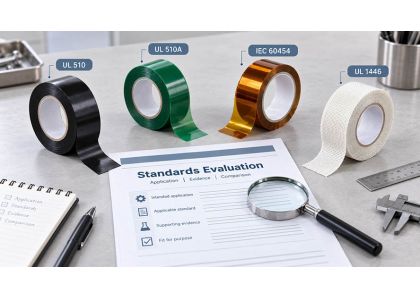
Suppose you ask two suppliers for UL-certified electrical tape. One sends a certificate; the other asks whether the tape will insulate a cable splice or hold a coil winding. Before chasing the second supplier for paperwork, answer that question. It changes which evidence you need.
Electrical insulation tape standards help you compare offers, but only when the documents match the job. This guide explains UL 510, UL 510A, IEC 60454 and UL 1446 through the decisions buyers actually face: which rating applies, whether a report covers the quoted construction, and what to ask when it doesn’t.
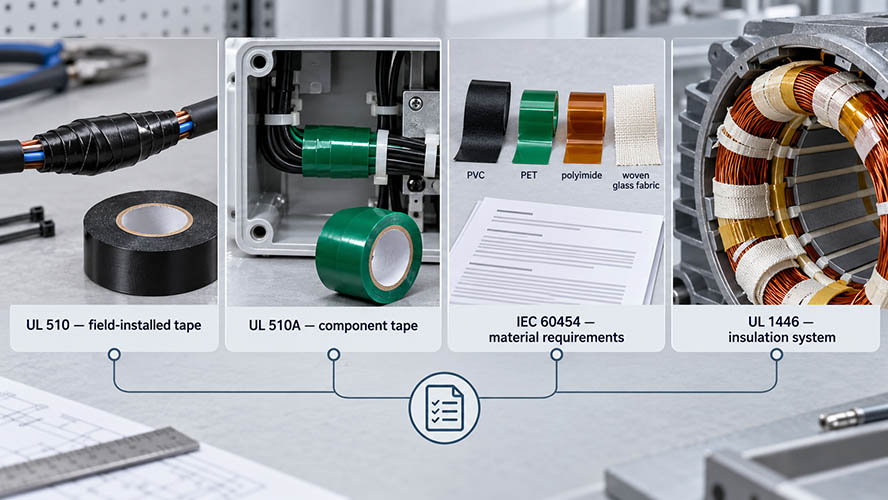
For wire and cable joints and splices, UL 510 covers PVC, polyethylene and rubber insulating tapes in its U.S. scope, at up to 600 V and 80°C. Canada’s PVC requirements sit under CSA C22.2 No. 197; UL 510 covers polyethylene and rubber tapes there. (UL 510, §§1.1–1.2)
UL 510A covers component tapes for finished electromechanical products. However, some tapes within its scope undergo only thickness and flammability testing. A standard number on a quotation therefore needs a category and a defined use beside it. (UL 510A, §§1.1–1.3)
UL Listed electrical tape and UL Recognized component tape follow different certification paths. Recognition assesses a component for incorporation into equipment under specified conditions; suitability still depends on the finished product. (UL, Component Recognition)
In a UL record, check the Category Control Number, or CCN:
|
Tape category |
United States |
Canada |
|
Listed insulating tape |
OANZ |
OANZ7 |
|
Recognized insulating component tape |
OANZ2 |
OANZ8 |
|
Recognized miscellaneous component tape |
OARC2 |
OARC8 |
Miscellaneous component tape requires additional suitable insulation when used in contact with live parts. Also confirm Canadian certification coverage when supplying Canada; U.S. coverage alone leaves that question open. (UL, tape categories and Canadian certification)
For comparing electrical insulation duties, describe the tape’s role before debating certification labels. Coil holding and an electrical barrier can require different evidence even within one assembly.
The functional details can be quite specific. One published UL tape record separately identifies insulation in dry and damp locations, plus adhesion used to maintain position or spacing. Reading only its temperature entry would miss those distinctions. (UL, insulating tape record E52811)
A real document illustrates the problem better than a generic warning. A June 2022 vinyl electrical tape datasheet lists 80°C and 600 V under UL 510, 105°C and 1,000 V under CSA C22.2 No. 197, and a 90°C thermal index under its IEC classification. All describe the same product under different requirements. (3M datasheet, pp. 1–2)
Picking the highest temperature from the page would lose that distinction. If an offer says “105°C, UL Listed,” ask the supplier to identify which approval supports the temperature for your application. The numbers may be legitimate while their combination in the quotation remains unclear.
IEC 60454 separates general requirements, test methods and material specifications into Parts 1, 2 and 3. For purchasing, the material sheet is where a broad claim becomes specific. (IEC 60454-1; IEC 60454-2)
|
Construction |
Sheet to check |
|
PVC film with pressure-sensitive adhesive |
|
|
PET film with specified rubber or crosslinked acrylic adhesives |
|
|
Polyimide film with specified pressure-sensitive adhesives |
|
|
Glass fabric with pressure-sensitive adhesive |
|
|
PET film combinations, including glass filament reinforcement |
These sheets describe defined constructions. The PET sheet specifies thermosetting rubber, thermoplastic rubber or crosslinked acrylic adhesives. Simply identifying the backing as PET doesn’t settle applicability. (IEC 60454-3-2, scope)
Ask for the sheet, edition and tape type covered by the evidence. For reinforced tape, get the layer construction too: woven glass cloth and glass filaments combined with PET are different descriptions.
If a supplier sends selected test results, ask whether they support selected properties or the complete material specification. Either can be useful, but they answer different purchasing questions.
Keep broader material comparisons separate from this check. A familiar backing material helps narrow the search; it doesn’t certify the finished adhesive tape.
A replacement tape arrives with a higher temperature rating and a lower price. Can it go straight into an existing motor winding assembly?
First identify the insulation system and the tape’s role within it. UL 1446 evaluates electrical insulation systems where thermal aging dominates. It does not establish or change the thermal ratings of individual components, and its scope excludes systems operating in oils or refrigerants. (UL 1446, §§1.1–1.3)
Compatibility matters even when a tape mainly holds materials in place. UL’s sealed-tube service evaluates whether gaseous degradation products from additions such as fastening tapes harm existing system materials. After aging, winding-wire insulation is checked for additional deterioration. That explains why a successful wrapping trial cannot answer every substitution question. (UL, sealed-tube chemical compatibility testing)
For a proposed substitution, ask the certification engineer which system conditions and evaluation route apply. Record the accepted material designation before changing the bill of materials. Treat a supplier’s heat-resistance report as supporting information, not permission to make the switch.
An ASTM D1000 electrical tape report can contain adhesion, tensile and dielectric results. ASTM D149 and IEC 60243-1 provide electrical-strength test methods. These identify how properties are measured; citing them alone does not establish product certification. (ASTM D1000; ASTM D149; IEC 60243-1)
Imagine ordering a thinner version than the sample in the report. Ask which evidence covers the quoted thickness, rather than assuming the family name transfers the result. Likewise, compare conditioning and test procedures before treating two breakdown values as equivalent.
RoHS and REACH documentation belongs in the purchase file for a different reason: chemical compliance. It cannot establish insulation performance. (European Commission, RoHS; ECHA, substances in articles)
Check the sample identity and referenced requirements. A REACH SVHC declaration should identify the Candidate List update assessed; a halogen-free report needs defined substances, methods and limits. Ask for the document relevant to your customer’s requirement instead of requesting every available certificate.
Use UL Product iQ to connect the quoted designation with its record, ratings and Conditions of Acceptability. These conditions help establish whether the component fits the intended equipment. (UL, certification data and acceptability conditions)
Then compare four things:
· Identity: complete designation and meaningful suffixes.
· Coverage: certification category, destination and intended function.
· Construction: relevant thickness, adhesive and applicable restrictions.
· Supply: the relationship between seller, certification holder and delivered tape.
A distributor’s name need not match the certification holder’s. UL also provides Multiple Listing arrangements for products supplied under different brands. Request a documented connection rather than rejecting a legitimate supply route. (UL, Multiple Listing)
For OEM tape orders, agree how the approved designation appears on specifications, roll labels and order documents.
A useful RFQ states the destination, end equipment, tape duty, dimensions, operating conditions and required documents. Ask the supplier to return the proposed designation, supporting file or report, and any gaps. Separate “information missing” from “requirement not met”: each needs a different response.
If the customer’s drawing merely says “UL tape,” clarify that requirement before comparing quotations. Send the supplier the relevant specification or intended equipment requirement, with confidential details removed where necessary. Otherwise, both sides may agree that a tape is “certified” while referring to different functions, markets or constructions throughout the discussion.
A precise follow-up could read: “The report covers a different thickness from your offer. Please identify the evidence covering the quoted construction, or confirm that this item remains unverified.” That gives the supplier a specific issue to resolve.
Before approval, keep a record of both the assembly trial and document review. Passing one does not close the other.
Ask for the public certification record and relevant ratings and acceptability conditions first. Proprietary construction details may remain confidential. If essential conditions are still unavailable, keep approval open and arrange clarification through the certification body rather than accepting a certificate cover page alone.
Compare its edition with the project requirement and the standard’s current status. An older report is not automatically useless. Ask whether changes affect the assessed construction or acceptance criteria, and obtain an agreed gap assessment where needed. Report age alone is a poor acceptance rule.
For example, UL’s July 2025 reaffirmation of UL 1446 updated approval dates without changing requirements. A new publication date need not mean new tests. (UL 1446, July 2025 summary)
Ask for corrected wording and confirm which certification the equipment requires. Recognition may be the appropriate route. Keep the corrected designation and scope with the order; requesting a different label without checking the end use can send the supplier in the wrong direction.
Those similarities support screening, not final substitution approval. Check the adhesive, recognized functions and any insulation-system restrictions. A mechanically suitable alternative may still need system compatibility evaluation. Ask what changed in the construction and which evidence covers that change.
Yes, but request traceability to the covered tape. Record the original designation, converter’s code and supplied format, then confirm applicable certification and labeling arrangements. A commercial cross-reference helps identify material; it does not by itself authorize a new certification claim.