
info@jxgreentape.com
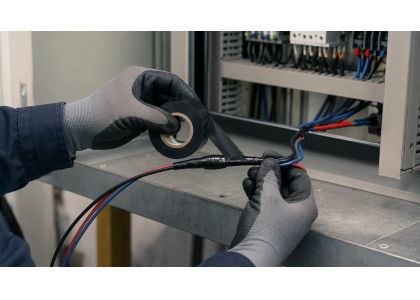
Table of Contents
Defining the Tape’s Role in the Finished Splice
A Documented PVC Tape Cable Repair Examined by MSHA
Reading Thickness, Adhesion and Electrical Data
Elongation Data and Application Tension
Temperature, Moisture and Outdoor Exposure
UL 510 Verification for PVC Electrical Tape
Diagnosing Edge Lift, Cracking and Adhesive Movement
Information to Include with a Sample Request
FAQ
At a control-panel assembly bench, PVC electrical tape is normally opened after an approved connector has made the joint. The tape may then overwrap the connection where the project permits tape insulation, protect a jacket repair, smooth a diameter change or add an identification band. Each task makes different demands on the tape.
That distinction is the practical starting point for anyone buying PVC electrical tape for wire splicing. Color, width and length are enough for a quotation, but not for approval. The finished splice also has a voltage, cable material, connector profile, temperature range and inspection requirement. These conditions—not a vague request for “good quality”—should define the sample trial.
The first useful word in a purchase description is often a verb: restore, overwrap, repair or identify.
Restore means rebuilding insulation over an approved splice. In US general-industry workplaces, OSHA 1910.303(c)(3)(i) requires an identified splicing device or another permitted joining method, followed by equivalent insulation or an insulating device identified for the purpose. Tape does not replace the connector. Other markets have their own applicable codes.
Overwrap adds protection over an approved insulation or sealing construction. A jacket patch does not automatically restore the original cord or cable rating. Identification colors must still match project or market rules.
This functional description prevents one inexpensive PVC insulation tape from being assigned several unqualified jobs. If PVC may not suit the duty, review the wider Electrical Insulation Tape Solutions range.
In 2003, the US Mine Safety and Health Administration examined a mine trailing-cable repair made with an approved Plymouth Rubber tape-splice kit. Identified PVC tape covered localized conductor-insulation damage and rebuilt the profile; a separate jacket wrap overlapped the original jacket as instructed.
MSHA found the kit components compatible and the assembly adequately insulating. Importantly, this repair was not the cause of the fatal accident behind the investigation; damaged areas on another energized cable caused the exposure. The construction and findings appear in the MSHA investigation report.
The finding applied only to that approved kit, its identified materials and the examined cable. It does not create a universal layer count. Approve the complete repair method, not a roll considered separately from the connector, cable and outer protection.
Within similar PVC-film and adhesive constructions, thinner tape creates less build and may follow small diameters more easily. A thicker tape builds coverage faster but may be less forgiving at abrupt profile changes. Thickness establishes neither working voltage nor wrap count.
Our PVC electrical tape range lists nominal thicknesses of 0.11, 0.13, 0.15, 0.18 and 0.20 mm and lengths of 5, 10, 15 and 20 m. Those dimensions narrow the handling trial; grade-specific documents must establish electrical, thermal, flame and environmental suitability.
Keep width, substrate and wrapping method constant when comparing samples. If thickness, adhesive construction and operator all change in one trial, a failure is difficult to interpret. For replacement work, test the closest available thickness to the approved incumbent and one adjacent option. Distributors serving several industries should resist approving one universal grade solely because it performed well on a single cable jacket.
Five data points deserve a careful read.
Total thickness should cover the complete construction, not only the film. Adhesion to steel provides a reference; adhesion to backing better represents layer-to-layer holding. Neither predicts every cable-jacket bond, which can change with plasticizers, surface energy, contamination and texture.
Tensile strength and elongation describe mechanical behavior, not installation tension. For electrical performance, identify whether the result is breakdown voltage or dielectric strength. One is a specimen voltage; the other is expressed relative to thickness. Compare results only when thickness, conditioning and test method are known.
ASTM D1000 contains separate methods for thickness, adhesion, strength and elongation, dielectric breakdown, flagging and other properties. A datasheet should state the tested property, result, unit and conditioning. Citing ASTM D1000 alone is not a blanket pass mark.
Do not divide laboratory breakdown voltage by circuit voltage to calculate wrap count. That shortcut ignores joint geometry, aging, contamination and applicable design requirements.
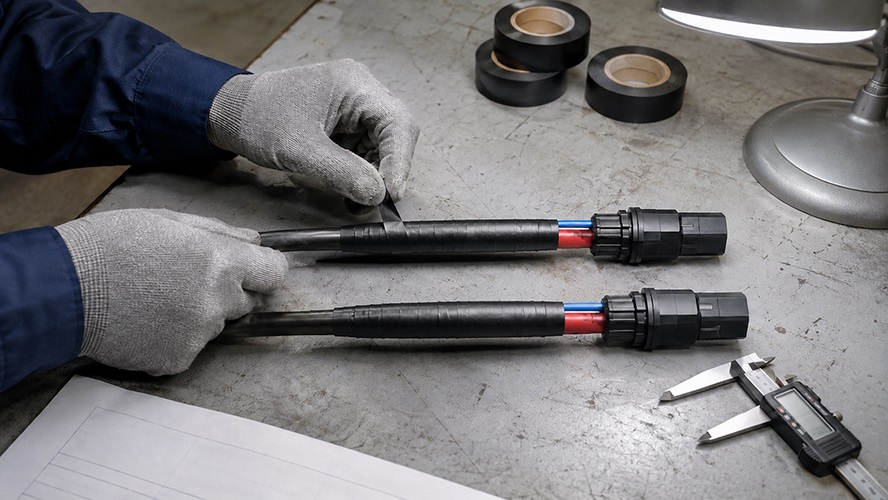
Elongation at break is a destructive laboratory endpoint, not an installation instruction. Heavy stretching stores recovery stress in the backing; around a small connector shoulder, that stress may lift the final turn.
Controlled tension may help tape follow a diameter change, but permitted tension depends on its construction and instructions. During a trial, compare applied width with an unstretched strip. Marked narrowing can reveal that stretch is forcing a poor fit.
Lay the final turn with little or no tension and press it firmly. Record the trial method; otherwise, two plants may approve the same roll under different application conditions.
“Indoor” is not a temperature rating. A cabinet near a heat source may run above room temperature, while winter maintenance may occur before it warms up. Ask separately for minimum application temperature and documented service range.
Check low-temperature flexibility, adhesive wet-out and post-heat edge stability on the actual jacket. More layers cannot turn PVC into a higher-temperature material. The PVC versus glass cloth electrical tape comparison covers when another backing deserves evaluation.
Do not specify an overlapped PVC wrap as watertight unless the complete splice, including end transitions and sealing method, has been qualified. Direct burial, washdown, condensation and humidity are different exposures.
For outdoor work, request grade-specific evidence for sunlight, moisture and temperature. For “flame retardant PVC electrical tape,” request the test method, result, exact product covered and report.
For the US, PVC insulating tape may be evaluated under ANSI/CAN/UL 510; for Canada, UL Solutions identifies CSA C22.2 No. 197. Recognized Component tape follows UL 510A and is intended for complete equipment or systems. UL Solutions’ certification guide explains the categories.
Verify the legal manufacturer, exact designation, category and active database record. “UL type,” “tested to UL 510” and a sample logo do not replace a matching listing. Without one, record the grade as “not verified as UL Listed.”
When certification is mandatory, check it before negotiating private-label artwork or a production order.
When a trial wrap lifts, inspect where and how. A tail narrower than an unused strip suggests excessive tension. Oily residue or dust points to surface preparation. Lifting only at the connector shoulder suggests poor conformity or an unsuitable wrapping path.
Cold cracking points first to application temperature and backing flexibility; adhesive squeeze-out after heat suggests temperature or compatibility issues. Photograph the specimen, retain a control roll and record time, temperature, substrate and method. That evidence is more useful than “not sticky enough.” See the Failure Analysis section for further diagnostic guidance.
A quotation based only on color, width and length is technically thin. Tell the PVC electrical tape supplier the intended function, voltage, connector type, jacket material, environment, application and service temperatures, and required certification.
If the jacket material is unknown, send a photograph, cable sample or datasheet. For replacement work, include the incumbent specification and reason for changing it.
Add dimensions, estimated quantity, destination market and private-label needs. Agree test methods, tolerances and incoming-inspection limits after a construction passes the first trial. The industrial tape buying guides cover that stage in more detail.
Before approving bulk PVC electrical tape, test it on the actual connector and jacket at realistic temperatures. Recheck edge lift, cracking, adhesive movement and layer-to-layer holding after the agreed conditioning period. Retain the approved sample, TDS revision and batch identification for incoming inspection.
Send the tape function, jacket material, connector profile, dimensions, temperatures, destination market and annual quantity. We can recommend a candidate construction for your approval process and provide its available grade-specific documents.
Related Articles: